Showing posts with label homestead. Show all posts

Sunday, April 27, 2014

Ch-Ch-Changes and Tips for Naming Your Farm

For six years now, my little farm has gone by the name "Wonderland Farm." I chose that name back in 2008 when I bought my first two Nigerian Dwarf does, and I registered "Wonderland" as my herd name*. I chose the name because Alice in Wonderland is one of my favorite children's books, and I was enamored with the idea of wonderlands and neverlands during that time in my life. I thought Wonderland would be perfect to illustrate my love of reading, capture my desire for my farm to be a real-life wonderland, and show that I keep a bit of childhood with me.

Fast forward to 2013, and ADGA -- the biggest dairy goat registry in the states -- has decided to register Nigerian Dwarf goats for the first time. Yay! Right? Yes. But there was a problem: "Wonderland" was not available as a herd name with ADGA. I had to change my herd name, and my options were not great. "Wonderland Farm" is far too long and took up half of the allotted space for a goat's registered name. "WNDRLNDFRM," with or without a space, just doesn't look appealing, in my opinion. And Wonderland27, which is what I initially chose to change to, is still pretty long, kinda a mouthful, and to be honest, I don't like the way it looks on paper, either. The 27 does correspond to one of my favorite Bible passages (Prov 27), but it doesn't make as much sense and, I feel, makes it very obvious that this was not my first choice for herd name. I don't want a herd name that necessitates explanation. "Why is there a 27 on your herd name...?"

I struggled with my herd name off and on for months. I considered changing it to WLF, but that doesn't capture anything personal to me or my farm nor does it sound like a farm name. It is initials. If a potential buyer who was previously unfamiliar with my farm saw WLF in a goat's name that I had bred, he or she would have to actually do research to find out who the breeder was. It does nothing to market or brand my goats or my farm to the public. If one day I should be so lucky as to have bred a top ten producer or other well-titled goat, I want the public to have a farm name to look up and be familiar with -- not an acronym. 

This struggle with my herd name led to a greater struggle with my farm name in general. I found that Wonderland Farm doesn't really fit me or my vision anymore. I was a teenager when I chose that farm name, and although I don't dislike it, I realize now that it doesn't send the message I want nor is it easily marketable. The biggest issue is that Wonderland is such a popular and common idea (which is why the herd name was unavailable in the first place). If you Google "Wonderland Farm," the entire first page of results is filled with a horse ranch in North Carolina. I also feel that Wonderland Farm has too much of a juvenile vibe to it. I want a farm name that can grow as the farm grows, that is mature (though not overly serious), that can accurately reflect myself and my farm, and that can be marketed without too much competition as far as other farms already having the same name. Wonderland doesn't really work with that. It was time for a change. 

That, in a nutshell, is how Wonderland Farm became Tiramar Farms in 2014. It took quite a lot of brainstorming and spit balling ideas, but we finally came up with a name that fulfills all of what I wanted from a farm name. It is, as far as I know, completely unique. A Google search reveals no other Tiramar Farms. The change from Farm to Farms also allows much more room for growth; I no longer just have goats, after all. I like that it was truly a collaborative effort that birthed this name. I could not have come up with it without the help of my mother, and I could not have made the decision with confidence if not for the consultation of my father and my close friends. It also contains part of the name of one of the first goats on whom I really learned to milk**, making it more personal to me and my experience than Wonderland. Lastly, it has a pleasing sound as well as appearance, and it gives off the overall vibe I was going for, at least in my opinion. Tiramar sounds mature but not stuffy, elegant but not pretentious, and more like a place-name than a human name (I've never been a fan of having my own name in my farm name, though that certainly works well for others). It just sounds pleasing on the ears and lends itself well to the overall feel of my farm.

When I showed my best friend, Sarah, the new logo I designed for Tiramar, she made the comment, "It's like the little girl from the old logo grew up." I loved that she thought of that, because that is exactly what happened! Like I said, I was a teenager when I named the farm Wonderland, and I'm not a teenager anymore. As we grow older our tastes, desires, dreams, and goals shift. We reevaluate things, and sometimes that means even reevaluating a name that has been with us for six years. It's a little nostalgic to see the old name go, but I love the new name. I am happy to say that I believe that Tiramar is a name I can stick with for the long haul.

As a refresher for those who may not remember the old logo...this is what I once used:


And this is what I use now:


(Can I just say that I love that the woman in my new logo has bare feet? Because I am always going barefoot whenever I can!)

So now that my story is out of the way and any confusion about the name change has hopefully been cleared up, here are a few tips on naming your farm, from me to you:
  1. Make it Unique. You truly don't want your farm to share a name with a bunch of other farms.When someone tries to look you up to buy your products, you want your farm to at least be on the first page of search results, if not the first result period. You also want any herd names that you need to register to be available. Not every farm will be raising registered livestock, but if you are or even might be in the future, this is important. Most purebred registries, regardless of species, require this type of naming.

    Making a unique name can be more difficult than you think, though. Always be sure to search the internet for the names you're considering before you get too attached. Taking the next two points into mind will help you make it unique as well.
  2. Make it Memorable. What's memorable? A name that's unique, of course! But I'm not trying to talk in circles here. You want your customers to be able to remember your farm name so that if they lose your information they can find it again, and so that when they're telling their friends about your great farm they can remember a name to pass on.

    So, what makes a name memorable, aside from uniqueness? Well, it shouldn't be overly difficult to pronounce or too long. If it's in a foreign language, choose a simple word with only a couple of syllables (Adios Acres rather than Rancho Cielo Morado, for example). Consider making up your own word; doing so will make it more unique, and therefore more easy to remember. But still stick with fairly simple, easy to pronounce words. We did this with my farm name, Tiramar, and I know of a farm called MigMog Acres.
  3. Make it Personal. This could be done in many ways. Survey your landscape: is there anything interesting about it that you really love? I heard of a farm named One Ash Farm, presumably because they had only one ash tree. Do you have a dear loved one who has passed away that you would like to honor? A particular quirk unique to your or your family? A special animal that helped found your farm?

    Making your farm name personal will make it mean that much more to you, and also help it to be more unique. However, be sure it's not such a private story or inside joke that others won't be able to connect to it.
  4. Leave Room for Growth. This was a mistake I made in first naming my farm; the original name was too confined to a specific theme or idea. There's more than one way to not leave room for growth, though. For instance, Hippie Chick'n Farm might seem really cute at the time, but what happens when you decide to add on other species of livestock? Five Harpers Farm is nice, too, but what if you have another child? Obviously these specific situations may not apply to everyone, but it's important to remember that your life might take you to unexpected places. Try not to let your farm name fence you in.
  5. Consider Marketing. At some point, you are going to need to generate a market for your farm so that you can also generate revenue. Even if you don't want your farm to be a business, it's likely that at some point you will need or want to sell excess eggs, honey, baby livestock, etc. You want a name that can be marketed. All of the other points in this list play into marketing as well, but putting some thought specifically into how your farm name will affect marketing is not a bad idea. You may want to make clear what your products are (Pint Size Poultry, for example, would market bantam birds or quail well), but then you also run into the risk of narrowing your room for growth. If you want to market multiple things, don't make your name refer to only one aspect of your farm.

    It's also best to keep your name in good taste: a vulgar or off-color name will likely ostracize some of your potential clients and may prevent you from advertising in certain locations or publications. Remember that many parents love to take their kids to farms or farmer's markets -- if your name isn't child friendly, you drastically cut your clientele. Speaking of clientele, remember your target demographic when naming your farm. A farm selling women's bath products will benefit from a drastically different name than would fit a farm offering a haunted corn maze. If you want to market to a wide demographic, keep the name neutral.
  6. Consider Your Theme/Vibe/Etc. Do you want humor associated with your farm? Whimsy? Romance? History? A name can evoke a certain feeling or imagery very easily. A prominent farm in Illinois goes by the name of Antiquity Oaks. That name combines the image of oak trees with the idea of antiquity, suggesting a historical, or traditional method of farming on a property with oaks. Some people choose to go with their own name for their farm, such as Parham Farms, a wonderful goat farm in Tennessee. Using your name in your farm name denotes a family vibe and brings to mind the human element in the farm. Think of what you value, and what your goals, hopes, and dreams are for your farm, and try to structure your name in such a way that it reflects your chosen theme or the feeling that you want to evoke in others when they hear your farm name.
  7. Consider Your Tagline. This is a key tool in marketing. A name can say a lot, but it can't say everything. That's where your tagline comes in. The tagline of your farm can be used to convey your personal code of operation, your values, or something about what you do or your products. Not every farm has a tagline, but I personally believe that a tagline is a good idea for sharing with others what your farm is about in a very concise manner. My tagline is "History. Heart. Hard Work." My mother helped me come up with this tagline, which makes it all the more appropriate. It's alliterative, which makes it memorable (and we already know how important that is), but it also speaks to some of my core values as they pertain to the farm. History indicates my belief in tradition and doing things in an "old fashioned" way, and it also speaks to the importance of my own personal history. I am a fourth generation farmer on my dad's side of the family, and on my mom's side I am a third generation goatherd (my grandmother, mother, and now myself have owned goats; in fact, one of my mother's goats knocked me out when I was a child). Heart speaks to the love that goes into everything I do in my farm and the importance of my family. Hard Work is pretty self-explanatory: a farm takes a lot of hard work! It is the goal to call to mind at least some of these notions for those who read my tagline.

    What's your message? Compress it to its most basic form and then make it your tagline.
  8. Make Sure It Can Stick Around. I know that this post is all about how and why I changed my farm name. Fair enough! But realistically, you aren't going to be able to change your farm name in the future, and if you do you'll likely only get one more chance at picking a good one. I got lucky; the reason I was able to change mine is partly because it made sense practically (just being discontent with a name is not really enough reason to go through the trouble and expense of changing it) and partly because I did not have a huge audience at the time of changing it. Even though my farm had been around six years, two of those years were in a sabbatical from breeding and my farm had been no more than a small hobby for the rest. I hadn't marketed my "brand" much yet, which meant that I would not be confusing many people, undoing years of getting my name out, or replacing tons of marketing supplies like business cards. Make sure that your name is one you can live with for a long time, because once it gets out there it will be hard to change it without potentially hurting your business.

That's all, folks! As always, thanks for reading.


*If your are unfamiliar with what a herd name is, it is the name goat breeders register with breed registries as the first part of each goat's name. Breeders of registered goats must have a herd name so that each animal they breed will be identifiable as bred by that breeder, and so that each animal recorded in the registry has a unique name. Instead of having 100 goats registered as "Hilda," each Hilda would be recorded as "Tiramar Hilda," "Oak Hill Farm Hilda," or "Happy Udders Hilda." 

**I am referring to my dear MiniMancha doe, Tiramisu, though I was learning to milk on sweet Abigail at the same time (whose face graces the top of this blog). Although both of these girls will always hold a special place in my heart (as many others do as well), "Tira" lends itself best to a farm name. "Abbymar" just doesn't have the same ring to it, nor does "Browniemar" even though she was my our first founding doe.


Tuesday, June 25, 2013

Gape Worm

No that is not a typo, and I didn't mean to say tape worm. We're talking about gape worm with a G (Syngamus trachea).

Yeah, I had never heard of it either.

I learned about this parasite only after one of our chickens became ill. Dad had noticed her acting 'weird' the day before, but we all thought she was just doing some strange chicken behavior. Chickens can behave strangely at times, and usually it's nothing to be concerned about.

This time, though, the behavior meant something more than a chicken being a chicken. When I let the chickens out of their coop to free range yesterday morning (we lock them up at night to protect them from predators), I noticed one of the hens was already outside of the coop. Now that is extremely unusual, because 99% of the time all of the chickens are back on their roosts by dusk. It's like clockwork. So I knew automatically that something wasn't right.

I went to check her out, and she let me walk up and pick her up with no protest. Another red flag for our chickens, who -- although calm around people -- do not like being caught. She had zero injuries or signs of a predator attack, but she was definitely not doing well. I brought her up to the house to watch her more closely. The symptoms she was exhibiting were some I'd never seen before. First of all, she had the hiccups. (Who knew chickens could even get hiccups?) Secondly, she was breathing heavily, and with every breath she would stick her head way up in the air, inhale as big as possible, and then slowly pull her neck back down to her chest and hang her head. She also had mucous on the tip of her beak.

So off we went to Google. Dad found the culprit first, and I looked up and read what he had found as well. The diagnosis was almost undoubtedly gape worm, and I believe the mucous was an indication of a secondary respiratory infection brought on by the parasites.

So what is gape worm? A nasty, nasty little bugger. The worms set up shop in the birds trachea and feed off their blood. Thinking about it makes me want to gag. Having worms in your trachea must be one of the worst sensations ever. The worms slowly suffocate the bird by blocking off their airway (hence the hiccups, labored breathing, and stretching to try to open the airway). According to what I've read, if the obstruction doesn't kill the birds, a secondary infection usually does.

There were several treatments listed, including fenbendazole (Safeguard), ivermectin, and moxidectin (Cydectin). I had Cydectin on hand, so that was the treatment plan I went with. I wanted to dose her as quickly as possible in the hopes of saving her. I also moved her out of the heat and humidity and onto our air conditioned back porch in the hopes that cool dry air would help her breath. I also offered apple cider vinegar spiked water, but she didn't drink any.

Unfortunately she showed no improvement; instead, she got steadily worse. Dad and I talked it over and decided she most likely wasn't going to make it, and it would be cruel to let her suffocate to death.

So what do we need to know about gape worm?

  • Gape worms can be carried and transmitted by some of chickens' favorite snacks, including red worms and slugs. Wild birds can also be carriers.
  • You can check for gape worm by examining the throat/trachea of the bird by propping her neck open with something like a pencil. We did not do this (the thought really grosses me out, too), but it would be a good way to differentiate between a respiratory infection or gape worm if there was any doubt. Look up more thorough instructions before trying that, of course.
  • Gape worm is apparently most common in young birds and peasants, but can happen in any domesticated fowl. Being on the ground increasing the risk (i.e., free ranging).
  •  The only way to completely prevent it, it seems, would be to allow birds zero access to the ground. Since I believe that birds should be allowed to naturally forage, that is not an option.
  • Trying to minimize the amount of carriers in the soil or coop area might help. I treated our coop with diatomaceous earth.
  • Once a bird is infected, it can expel the eggs of the gape worm through its feces or by breathing. So if you have a symptomatic bird who has gape worm, she has probably deposited the eggs all over the place.
  • Based on what I have read, unless gape worm is caught very early the bird is not likely to survive. In my limiting experience and from what I have seen of what it does, I am inclined to believe that. Culling may be the best option unless its caught and treated very early.
I'm no expert, but this is what I have gleaned with my limited internet research.

I hate deworming or giving medication preemptively, but I absolutely believe in treating when necessary. For my goats, I use the FAMANCHA method combined with observing body condition to determine when I need to deworm. I have also been using smart drenching rather than treating on a schedule or treating every animal when one is infested. I also attempt to use natural means to prevent infestations: keeping things clean, feeders up off the ground, keeping water clean, keeping minerals accessible, and bolusing for copper. In the future I hope to be able to use rotational grazing. I will also be breeding for resistance.

But...chickens are a horse of a different color. There is no FAMANCHA method for birds (at least not that I'm aware of). We do work to keep housing clean, put DE under bedding, and allow them room to roam (crowding and confinement increase the spread of parasites). But chickens love to scratch and eat things from the ground, including those insects which are carries for parasites (and parasites themselves, I am sure). This leads me to my next point.

Knowing what I do about gape worm, the horrible way in which it kills, and the fact that our affected hen could have spread it literally all over our entire chicken area, I decided it would be best to deworm all the chickens as a preventative measure. My parents also agreed with this, and I was given the same advice from a friend who also has chickens. Though the dewormer I am using has no milk withdrawal period, it is off-label for chickens. That means no withholding time for eggs has been established or studied.

Which, unfortunately, means that for the next 30+ days, while the chickens are being dosed and the self-imposed withdrawal time to be safe, we will have no eggs to sell to others. We are truly sorry for the inconvenience, but we simply can't risk the health of our entire flock for the sake of being able to sell the eggs. Believe me, it totally sucks to know we'll be throwing out eggs during the middle of the peak laying season. *sigh*

Here are the links to the pages from which I gathered my information:

http://www.backyardchickens.com/t/87267/gapeworm-what-do-we-do
http://www.backyardchickens.com/t/419463/if-they-have-worms-what-is-the-treatment/10
http://en.wikipedia.org/wiki/Gapeworm
http://poultrykeeper.com/digestive-system-problems/gape-worm-or-syngamus-trachea
http://www.backyardchickens.com/t/602699/worming-chickens/10#post_7931055

Monday, June 17, 2013

Babies, Babies Everywhere!


I am only slightly exaggerating! Moma Hen's final chick count was six chicks out of nine eggs. (I originally thought I had ten eggs, but apparently I can't count.) Of course I would have loved for all nine to be successful, but I am certainly not complaining. Not one bit.


The best part is that all the chicks are thriving. In the past when I've had hens set, it usually turns out that at least one chick out of the bunch hatches but doesn't make it. Sometimes they have trouble hatching, and sometimes there seems to be no obvious reason other than that it just wasn't meant to be. But so far all these little ones are full of energy and spunk.


The funny part is that not a single one is black! I'm thinking our hen decided she didn't need to go through the trouble of laying when she had other hens generous enough to donate to her cause. In a way I am disappointed because I was hoping to carry on her broodiness in my flock by keeping a daughter from her, but on the other hand it will be a nice surprise to see how these little ones grow up. I know at least one is a RIR x EE cross. Also, perhaps broodiness is a learned trait more than a genetic one. We will see.


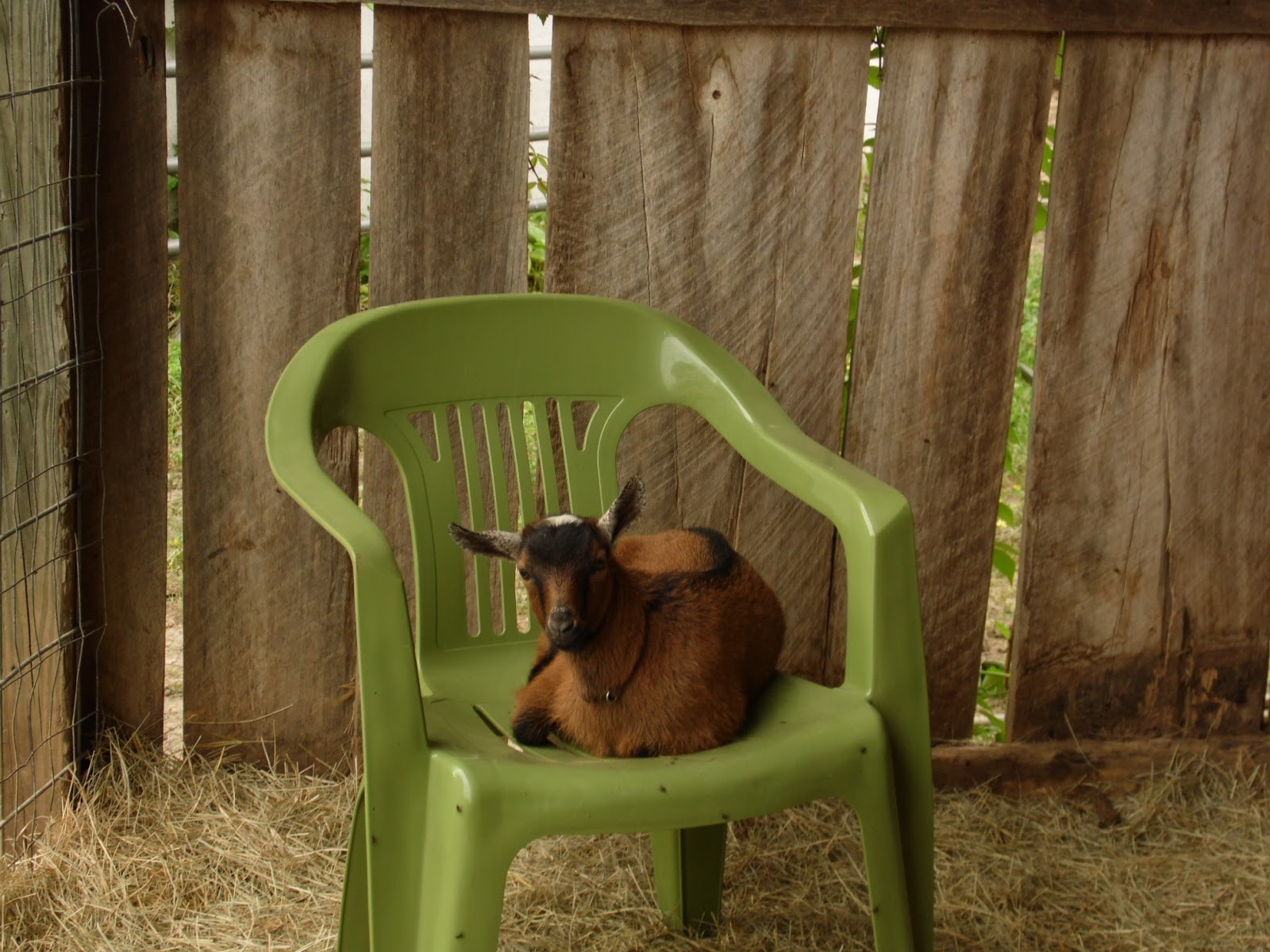
The other baby on board is our new buckling, Parham Farms DT Bazinga! He finally came to live with us here after being weaned. As you can see, he has certainly made himself at home.

Originally he was going to be staying in his own spacious pen with his own barn. I had cleaned the kid space out over the last week, installed a new hay rack, and even bought a dog house because that barn is a mostly open, lean-to style. I thought he would be more comfortable, warm, and secure feeling in a smaller enclosure while sleeping by himself at night. He was going to be sharing a fence line with the does, but not a barn.


That plan didn't work out, and in the picture above you can see why. Little 'Zinga is a loud mouth. I can't blame him considering he has just been separated from his mom and siblings and moved to a new place, but it still threw a hitch in my plans. I could just imagine every predator from miles around coming to snack on a goat kid buffet that night. Every cry surely translated to "Free food! Helpless baby over here! EAT ME!" in predator language. 

Luckily our doe barn is unique in that it was originally a horse stall and open overhang. When we converted it for the goats, we put up a panel fence and gate around the front and latched the stall door open, creating a connected space of two 10 x 10 areas. Normally I only use the partition to contain the does in one side when I need easy access to them for hoof trimming, deworming, etc, but it came in handy Saturday. 

I closed the gate to give the does one half and Bazinga the other. I moved Bazinga and his dog house (and my chair) over to the front half of the barn and let the does have the back, which is connected to their fenced area. The only problem so far is that the only hay rack I have for that barn is on the doe side, and the only mineral feeder is on Bazinga's. But I will deal with those minor inconveniences for a couple of weeks for the sake of knowing that Bazinga will be quiet at night because the does are there next to him, and that even if he isn't my LGD Lakota is right next door and could easily alert us or even climb the gate if some hungry hooligan tried any funny business.


Even though these babies are cuties, I'm excited to see how they grow up. The chicks will be a total surprise as their mature feathers come in. They could be any number of colors. As for Bazinga, I know he is going to be an impressive buck. He has the most incredible bloodlines and I'm already impressed by his conformation. I expect great things out of him!

Monday, June 10, 2013

Broody Mama


Most of us are aware that the majority of traits are passed down genetically, with the rest being learned or developed after birth. The breeders of commercial agriculture have cashed in by exploiting this simple fact and using it to create monocultures in livestock (and crops, but that's another story for another day). They have selectively bred their way to profits on top of profits by creating animals that produce the greatest amount for the least amount of investment.

Selective breeding is not a bad thing by any means. It can be a very beneficial tool. All serious livestock breeders use it to make their lines the best that they can be. Animals are selected for their ability to produce, their conformity to their breed standards, and their thriftiness. The ideal homestead or small farm animal is one that converts feed to production well while also adhering to standards set for the species and breed and maintaining optimal health with proper management and without an excessive need for medication or intervention. Carefully selecting breeding pairs based on their traits is necessary to producing good quality animals.

Commercialism takes this too far. They have bred down from a diverse collection of foundation animals that successfully produced good amounts of milk, meat, or eggs while still being able to function naturally to a handful of breeds that have been bred to do nothing but convert grain to massive amounts of food for these least amount of money. The ability for the animals to be able to live on pasture, stay healthy without too much human intervention, and breed naturally has become moot for commercial livestock breeders because they now possess the ability to feed them nothing but cheap grains, keep them pumped full of antibiotics, artificially breed them, and raise their young for them. They have traded the ability of an animal to be naturally sustainable for the benefit of higher profits.

There are a ton of risks and problems that this type of management creates, and I could spend all day going on about the inhumane practices and the detriment of this single-mindedness to the diversity and well being of heritage livestock breeds, but today I just want to focus on one aspect: The loss of natural mothering skills found in commercialized livestock, particularly poultry.

Broodiness, aka the instinct for a mother hen to set her eggs and rear her chicks, has been almost completely bred out of the commercial breeds. It is no longer important in the commercial agricultural industry for hens to be able to raise their own young, because their eggs can be taken and incubated by the humans. But the biggest reason this trait has been bred out is due to a loss of profits when a hen goes broody, because broody hens will not lay as well. When a mama bird has the urge to make some babies, she will stop laying and focus on hatching eggs. This means a loss of profit on that hen because she is not producing as well while she is trying to start a brood.

But broodiness is a beneficial trait for a homesteader or small farmer! Having a hen that will go broody when left with a clutch of eggs is invaluable for those of us who desire that our livestock not only be productive but also reasonably sustainable. If I have to incubate eggs or buy new chicks every time I need to refresh my flock, I am spending more time and money than necessary (because of course I can't do this as cheaply as a commercial hatchery) and my flock is not truly sustainable because it cannot reproduce itself. But if I leave a clutch of eggs with a broody mama who then does all the work of raising them for me, I have put forth much less effort for the replenishing of my flock. I have payed much less for the new chicks -- only the cost of feed, shavings, and water -- and I can take the set back of losing a hen's production for a while because I don't have as great a demand for eggs as someone whose entire income depends upon the production of their chickens.

And this is the way that homesteads and farms used to operate. They were diverse places that held several different species, and possibly breeds, of livestock and crops. They had less of a demand for one thing, and could make up for the lack of a few eggs from one hen by the fact that she would be bringing forth new stock that they didn't have to spend a ton of time or money on raising. They also didn't depend on one single thing to keep their farm working. Their homesteads were polycultures that worked symbiotically. Their animals may not have had twice as much weight on their frames as their bodies could actually support (I'm looking at you, commercial meat poultry), but they could do well with natural browse and could reproduce on their own. They didn't have to be constantly medicated or artificially inseminated in order to keep existing.

Release a flock of commercial broad breasted turkeys into a pasture and they probably wouldn't last a month.

All of this is why I am proud to say that I have a line of hens, stemming from my foundation stock, that will set eggs and raise chicks when given the opportunity. I was afraid I had lost all of my original stock to predators, but thankfully I know that at the very least I have one hen and one rooster that come from those first birds, and most specifically from that first hen who liked to go broody. I now have a beautiful Australorp x RIR cross setting ten eggs due to hatch the 15th of June. I know she is one of my home grown girls because she is mostly black with some red feathers -- clearly she came from an Australorp egg fertilized by my RIR rooster and reared by one of my first broody RIR hens. She may not be a pristine purebred, but I am proud of her nonetheless and am hoping her hatch will be successful.


There is a strange sense of pride in knowing that my animals know how to be animals. Of course they are given the care necessary to make their lives as successful, productive, and happy as can be, but it's nice to know that Mama Hen is out in her brooder keeping eggs warm and preparing to care for them naturally, which keeps me from having to invest in an incubator or the cost of purchasing and shipping chicks from a hatchery (which of course I had already done this year! Oops!)

Thanks, Mama Hen, for knowing to do what you were created to do, and thank you breeders who have not dumped all other breeds of chicken in favor of commercial layers and growers.