Showing posts with label broody hen. Show all posts

Monday, June 17, 2013

Babies, Babies Everywhere!


I am only slightly exaggerating! Moma Hen's final chick count was six chicks out of nine eggs. (I originally thought I had ten eggs, but apparently I can't count.) Of course I would have loved for all nine to be successful, but I am certainly not complaining. Not one bit.


The best part is that all the chicks are thriving. In the past when I've had hens set, it usually turns out that at least one chick out of the bunch hatches but doesn't make it. Sometimes they have trouble hatching, and sometimes there seems to be no obvious reason other than that it just wasn't meant to be. But so far all these little ones are full of energy and spunk.


The funny part is that not a single one is black! I'm thinking our hen decided she didn't need to go through the trouble of laying when she had other hens generous enough to donate to her cause. In a way I am disappointed because I was hoping to carry on her broodiness in my flock by keeping a daughter from her, but on the other hand it will be a nice surprise to see how these little ones grow up. I know at least one is a RIR x EE cross. Also, perhaps broodiness is a learned trait more than a genetic one. We will see.
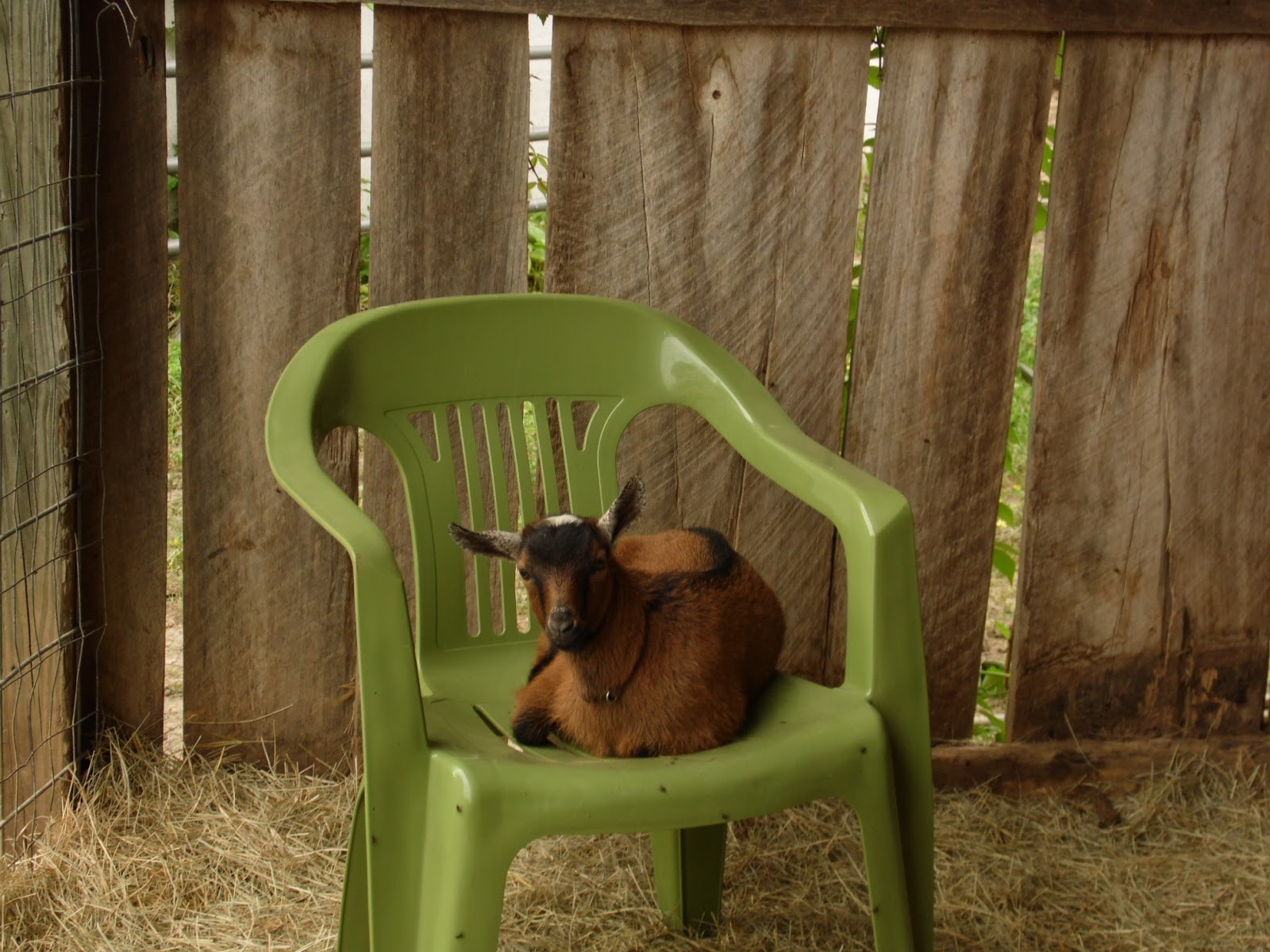

The other baby on board is our new buckling, Parham Farms DT Bazinga! He finally came to live with us here after being weaned. As you can see, he has certainly made himself at home.

Originally he was going to be staying in his own spacious pen with his own barn. I had cleaned the kid space out over the last week, installed a new hay rack, and even bought a dog house because that barn is a mostly open, lean-to style. I thought he would be more comfortable, warm, and secure feeling in a smaller enclosure while sleeping by himself at night. He was going to be sharing a fence line with the does, but not a barn.


That plan didn't work out, and in the picture above you can see why. Little 'Zinga is a loud mouth. I can't blame him considering he has just been separated from his mom and siblings and moved to a new place, but it still threw a hitch in my plans. I could just imagine every predator from miles around coming to snack on a goat kid buffet that night. Every cry surely translated to "Free food! Helpless baby over here! EAT ME!" in predator language. 

Luckily our doe barn is unique in that it was originally a horse stall and open overhang. When we converted it for the goats, we put up a panel fence and gate around the front and latched the stall door open, creating a connected space of two 10 x 10 areas. Normally I only use the partition to contain the does in one side when I need easy access to them for hoof trimming, deworming, etc, but it came in handy Saturday. 

I closed the gate to give the does one half and Bazinga the other. I moved Bazinga and his dog house (and my chair) over to the front half of the barn and let the does have the back, which is connected to their fenced area. The only problem so far is that the only hay rack I have for that barn is on the doe side, and the only mineral feeder is on Bazinga's. But I will deal with those minor inconveniences for a couple of weeks for the sake of knowing that Bazinga will be quiet at night because the does are there next to him, and that even if he isn't my LGD Lakota is right next door and could easily alert us or even climb the gate if some hungry hooligan tried any funny business.


Even though these babies are cuties, I'm excited to see how they grow up. The chicks will be a total surprise as their mature feathers come in. They could be any number of colors. As for Bazinga, I know he is going to be an impressive buck. He has the most incredible bloodlines and I'm already impressed by his conformation. I expect great things out of him!

Monday, June 10, 2013

Broody Mama


Most of us are aware that the majority of traits are passed down genetically, with the rest being learned or developed after birth. The breeders of commercial agriculture have cashed in by exploiting this simple fact and using it to create monocultures in livestock (and crops, but that's another story for another day). They have selectively bred their way to profits on top of profits by creating animals that produce the greatest amount for the least amount of investment.

Selective breeding is not a bad thing by any means. It can be a very beneficial tool. All serious livestock breeders use it to make their lines the best that they can be. Animals are selected for their ability to produce, their conformity to their breed standards, and their thriftiness. The ideal homestead or small farm animal is one that converts feed to production well while also adhering to standards set for the species and breed and maintaining optimal health with proper management and without an excessive need for medication or intervention. Carefully selecting breeding pairs based on their traits is necessary to producing good quality animals.

Commercialism takes this too far. They have bred down from a diverse collection of foundation animals that successfully produced good amounts of milk, meat, or eggs while still being able to function naturally to a handful of breeds that have been bred to do nothing but convert grain to massive amounts of food for these least amount of money. The ability for the animals to be able to live on pasture, stay healthy without too much human intervention, and breed naturally has become moot for commercial livestock breeders because they now possess the ability to feed them nothing but cheap grains, keep them pumped full of antibiotics, artificially breed them, and raise their young for them. They have traded the ability of an animal to be naturally sustainable for the benefit of higher profits.

There are a ton of risks and problems that this type of management creates, and I could spend all day going on about the inhumane practices and the detriment of this single-mindedness to the diversity and well being of heritage livestock breeds, but today I just want to focus on one aspect: The loss of natural mothering skills found in commercialized livestock, particularly poultry.

Broodiness, aka the instinct for a mother hen to set her eggs and rear her chicks, has been almost completely bred out of the commercial breeds. It is no longer important in the commercial agricultural industry for hens to be able to raise their own young, because their eggs can be taken and incubated by the humans. But the biggest reason this trait has been bred out is due to a loss of profits when a hen goes broody, because broody hens will not lay as well. When a mama bird has the urge to make some babies, she will stop laying and focus on hatching eggs. This means a loss of profit on that hen because she is not producing as well while she is trying to start a brood.

But broodiness is a beneficial trait for a homesteader or small farmer! Having a hen that will go broody when left with a clutch of eggs is invaluable for those of us who desire that our livestock not only be productive but also reasonably sustainable. If I have to incubate eggs or buy new chicks every time I need to refresh my flock, I am spending more time and money than necessary (because of course I can't do this as cheaply as a commercial hatchery) and my flock is not truly sustainable because it cannot reproduce itself. But if I leave a clutch of eggs with a broody mama who then does all the work of raising them for me, I have put forth much less effort for the replenishing of my flock. I have payed much less for the new chicks -- only the cost of feed, shavings, and water -- and I can take the set back of losing a hen's production for a while because I don't have as great a demand for eggs as someone whose entire income depends upon the production of their chickens.

And this is the way that homesteads and farms used to operate. They were diverse places that held several different species, and possibly breeds, of livestock and crops. They had less of a demand for one thing, and could make up for the lack of a few eggs from one hen by the fact that she would be bringing forth new stock that they didn't have to spend a ton of time or money on raising. They also didn't depend on one single thing to keep their farm working. Their homesteads were polycultures that worked symbiotically. Their animals may not have had twice as much weight on their frames as their bodies could actually support (I'm looking at you, commercial meat poultry), but they could do well with natural browse and could reproduce on their own. They didn't have to be constantly medicated or artificially inseminated in order to keep existing.

Release a flock of commercial broad breasted turkeys into a pasture and they probably wouldn't last a month.

All of this is why I am proud to say that I have a line of hens, stemming from my foundation stock, that will set eggs and raise chicks when given the opportunity. I was afraid I had lost all of my original stock to predators, but thankfully I know that at the very least I have one hen and one rooster that come from those first birds, and most specifically from that first hen who liked to go broody. I now have a beautiful Australorp x RIR cross setting ten eggs due to hatch the 15th of June. I know she is one of my home grown girls because she is mostly black with some red feathers -- clearly she came from an Australorp egg fertilized by my RIR rooster and reared by one of my first broody RIR hens. She may not be a pristine purebred, but I am proud of her nonetheless and am hoping her hatch will be successful.


There is a strange sense of pride in knowing that my animals know how to be animals. Of course they are given the care necessary to make their lives as successful, productive, and happy as can be, but it's nice to know that Mama Hen is out in her brooder keeping eggs warm and preparing to care for them naturally, which keeps me from having to invest in an incubator or the cost of purchasing and shipping chicks from a hatchery (which of course I had already done this year! Oops!)

Thanks, Mama Hen, for knowing to do what you were created to do, and thank you breeders who have not dumped all other breeds of chicken in favor of commercial layers and growers.