Tuesday, June 25, 2013

Gape Worm

No that is not a typo, and I didn't mean to say tape worm. We're talking about gape worm with a G (Syngamus trachea).

Yeah, I had never heard of it either.

I learned about this parasite only after one of our chickens became ill. Dad had noticed her acting 'weird' the day before, but we all thought she was just doing some strange chicken behavior. Chickens can behave strangely at times, and usually it's nothing to be concerned about.

This time, though, the behavior meant something more than a chicken being a chicken. When I let the chickens out of their coop to free range yesterday morning (we lock them up at night to protect them from predators), I noticed one of the hens was already outside of the coop. Now that is extremely unusual, because 99% of the time all of the chickens are back on their roosts by dusk. It's like clockwork. So I knew automatically that something wasn't right.

I went to check her out, and she let me walk up and pick her up with no protest. Another red flag for our chickens, who -- although calm around people -- do not like being caught. She had zero injuries or signs of a predator attack, but she was definitely not doing well. I brought her up to the house to watch her more closely. The symptoms she was exhibiting were some I'd never seen before. First of all, she had the hiccups. (Who knew chickens could even get hiccups?) Secondly, she was breathing heavily, and with every breath she would stick her head way up in the air, inhale as big as possible, and then slowly pull her neck back down to her chest and hang her head. She also had mucous on the tip of her beak.

So off we went to Google. Dad found the culprit first, and I looked up and read what he had found as well. The diagnosis was almost undoubtedly gape worm, and I believe the mucous was an indication of a secondary respiratory infection brought on by the parasites.

So what is gape worm? A nasty, nasty little bugger. The worms set up shop in the birds trachea and feed off their blood. Thinking about it makes me want to gag. Having worms in your trachea must be one of the worst sensations ever. The worms slowly suffocate the bird by blocking off their airway (hence the hiccups, labored breathing, and stretching to try to open the airway). According to what I've read, if the obstruction doesn't kill the birds, a secondary infection usually does.

There were several treatments listed, including fenbendazole (Safeguard), ivermectin, and moxidectin (Cydectin). I had Cydectin on hand, so that was the treatment plan I went with. I wanted to dose her as quickly as possible in the hopes of saving her. I also moved her out of the heat and humidity and onto our air conditioned back porch in the hopes that cool dry air would help her breath. I also offered apple cider vinegar spiked water, but she didn't drink any.

Unfortunately she showed no improvement; instead, she got steadily worse. Dad and I talked it over and decided she most likely wasn't going to make it, and it would be cruel to let her suffocate to death.

So what do we need to know about gape worm?

  • Gape worms can be carried and transmitted by some of chickens' favorite snacks, including red worms and slugs. Wild birds can also be carriers.
  • You can check for gape worm by examining the throat/trachea of the bird by propping her neck open with something like a pencil. We did not do this (the thought really grosses me out, too), but it would be a good way to differentiate between a respiratory infection or gape worm if there was any doubt. Look up more thorough instructions before trying that, of course.
  • Gape worm is apparently most common in young birds and peasants, but can happen in any domesticated fowl. Being on the ground increasing the risk (i.e., free ranging).
  •  The only way to completely prevent it, it seems, would be to allow birds zero access to the ground. Since I believe that birds should be allowed to naturally forage, that is not an option.
  • Trying to minimize the amount of carriers in the soil or coop area might help. I treated our coop with diatomaceous earth.
  • Once a bird is infected, it can expel the eggs of the gape worm through its feces or by breathing. So if you have a symptomatic bird who has gape worm, she has probably deposited the eggs all over the place.
  • Based on what I have read, unless gape worm is caught very early the bird is not likely to survive. In my limiting experience and from what I have seen of what it does, I am inclined to believe that. Culling may be the best option unless its caught and treated very early.
I'm no expert, but this is what I have gleaned with my limited internet research.

I hate deworming or giving medication preemptively, but I absolutely believe in treating when necessary. For my goats, I use the FAMANCHA method combined with observing body condition to determine when I need to deworm. I have also been using smart drenching rather than treating on a schedule or treating every animal when one is infested. I also attempt to use natural means to prevent infestations: keeping things clean, feeders up off the ground, keeping water clean, keeping minerals accessible, and bolusing for copper. In the future I hope to be able to use rotational grazing. I will also be breeding for resistance.

But...chickens are a horse of a different color. There is no FAMANCHA method for birds (at least not that I'm aware of). We do work to keep housing clean, put DE under bedding, and allow them room to roam (crowding and confinement increase the spread of parasites). But chickens love to scratch and eat things from the ground, including those insects which are carries for parasites (and parasites themselves, I am sure). This leads me to my next point.

Knowing what I do about gape worm, the horrible way in which it kills, and the fact that our affected hen could have spread it literally all over our entire chicken area, I decided it would be best to deworm all the chickens as a preventative measure. My parents also agreed with this, and I was given the same advice from a friend who also has chickens. Though the dewormer I am using has no milk withdrawal period, it is off-label for chickens. That means no withholding time for eggs has been established or studied.

Which, unfortunately, means that for the next 30+ days, while the chickens are being dosed and the self-imposed withdrawal time to be safe, we will have no eggs to sell to others. We are truly sorry for the inconvenience, but we simply can't risk the health of our entire flock for the sake of being able to sell the eggs. Believe me, it totally sucks to know we'll be throwing out eggs during the middle of the peak laying season. *sigh*

Here are the links to the pages from which I gathered my information:

http://www.backyardchickens.com/t/87267/gapeworm-what-do-we-do
http://www.backyardchickens.com/t/419463/if-they-have-worms-what-is-the-treatment/10
http://en.wikipedia.org/wiki/Gapeworm
http://poultrykeeper.com/digestive-system-problems/gape-worm-or-syngamus-trachea
http://www.backyardchickens.com/t/602699/worming-chickens/10#post_7931055

Monday, June 17, 2013

Babies, Babies Everywhere!


I am only slightly exaggerating! Moma Hen's final chick count was six chicks out of nine eggs. (I originally thought I had ten eggs, but apparently I can't count.) Of course I would have loved for all nine to be successful, but I am certainly not complaining. Not one bit.


The best part is that all the chicks are thriving. In the past when I've had hens set, it usually turns out that at least one chick out of the bunch hatches but doesn't make it. Sometimes they have trouble hatching, and sometimes there seems to be no obvious reason other than that it just wasn't meant to be. But so far all these little ones are full of energy and spunk.


The funny part is that not a single one is black! I'm thinking our hen decided she didn't need to go through the trouble of laying when she had other hens generous enough to donate to her cause. In a way I am disappointed because I was hoping to carry on her broodiness in my flock by keeping a daughter from her, but on the other hand it will be a nice surprise to see how these little ones grow up. I know at least one is a RIR x EE cross. Also, perhaps broodiness is a learned trait more than a genetic one. We will see.


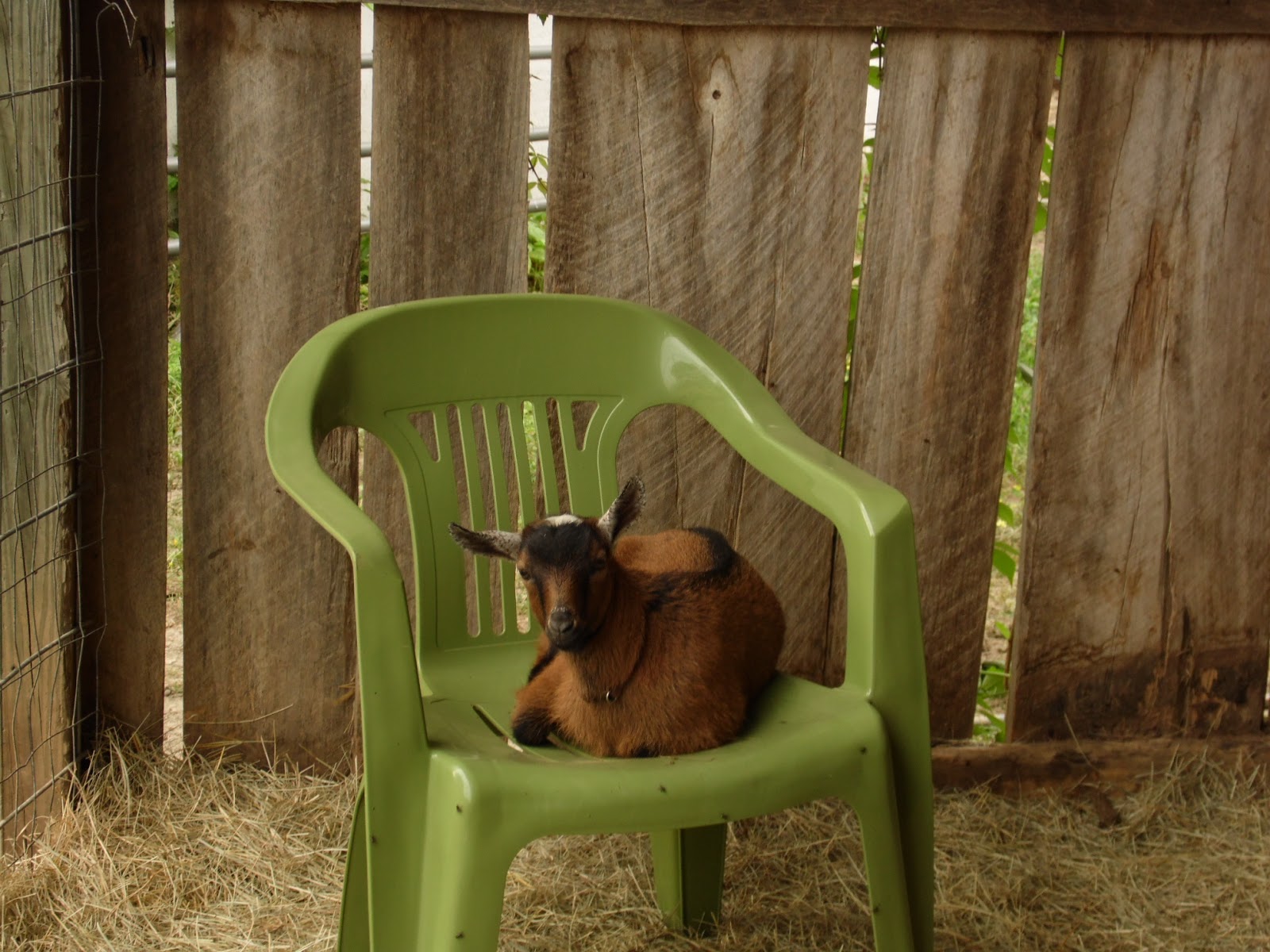
The other baby on board is our new buckling, Parham Farms DT Bazinga! He finally came to live with us here after being weaned. As you can see, he has certainly made himself at home.

Originally he was going to be staying in his own spacious pen with his own barn. I had cleaned the kid space out over the last week, installed a new hay rack, and even bought a dog house because that barn is a mostly open, lean-to style. I thought he would be more comfortable, warm, and secure feeling in a smaller enclosure while sleeping by himself at night. He was going to be sharing a fence line with the does, but not a barn.


That plan didn't work out, and in the picture above you can see why. Little 'Zinga is a loud mouth. I can't blame him considering he has just been separated from his mom and siblings and moved to a new place, but it still threw a hitch in my plans. I could just imagine every predator from miles around coming to snack on a goat kid buffet that night. Every cry surely translated to "Free food! Helpless baby over here! EAT ME!" in predator language. 

Luckily our doe barn is unique in that it was originally a horse stall and open overhang. When we converted it for the goats, we put up a panel fence and gate around the front and latched the stall door open, creating a connected space of two 10 x 10 areas. Normally I only use the partition to contain the does in one side when I need easy access to them for hoof trimming, deworming, etc, but it came in handy Saturday. 

I closed the gate to give the does one half and Bazinga the other. I moved Bazinga and his dog house (and my chair) over to the front half of the barn and let the does have the back, which is connected to their fenced area. The only problem so far is that the only hay rack I have for that barn is on the doe side, and the only mineral feeder is on Bazinga's. But I will deal with those minor inconveniences for a couple of weeks for the sake of knowing that Bazinga will be quiet at night because the does are there next to him, and that even if he isn't my LGD Lakota is right next door and could easily alert us or even climb the gate if some hungry hooligan tried any funny business.


Even though these babies are cuties, I'm excited to see how they grow up. The chicks will be a total surprise as their mature feathers come in. They could be any number of colors. As for Bazinga, I know he is going to be an impressive buck. He has the most incredible bloodlines and I'm already impressed by his conformation. I expect great things out of him!

Monday, June 10, 2013

Broody Mama


Most of us are aware that the majority of traits are passed down genetically, with the rest being learned or developed after birth. The breeders of commercial agriculture have cashed in by exploiting this simple fact and using it to create monocultures in livestock (and crops, but that's another story for another day). They have selectively bred their way to profits on top of profits by creating animals that produce the greatest amount for the least amount of investment.

Selective breeding is not a bad thing by any means. It can be a very beneficial tool. All serious livestock breeders use it to make their lines the best that they can be. Animals are selected for their ability to produce, their conformity to their breed standards, and their thriftiness. The ideal homestead or small farm animal is one that converts feed to production well while also adhering to standards set for the species and breed and maintaining optimal health with proper management and without an excessive need for medication or intervention. Carefully selecting breeding pairs based on their traits is necessary to producing good quality animals.

Commercialism takes this too far. They have bred down from a diverse collection of foundation animals that successfully produced good amounts of milk, meat, or eggs while still being able to function naturally to a handful of breeds that have been bred to do nothing but convert grain to massive amounts of food for these least amount of money. The ability for the animals to be able to live on pasture, stay healthy without too much human intervention, and breed naturally has become moot for commercial livestock breeders because they now possess the ability to feed them nothing but cheap grains, keep them pumped full of antibiotics, artificially breed them, and raise their young for them. They have traded the ability of an animal to be naturally sustainable for the benefit of higher profits.

There are a ton of risks and problems that this type of management creates, and I could spend all day going on about the inhumane practices and the detriment of this single-mindedness to the diversity and well being of heritage livestock breeds, but today I just want to focus on one aspect: The loss of natural mothering skills found in commercialized livestock, particularly poultry.

Broodiness, aka the instinct for a mother hen to set her eggs and rear her chicks, has been almost completely bred out of the commercial breeds. It is no longer important in the commercial agricultural industry for hens to be able to raise their own young, because their eggs can be taken and incubated by the humans. But the biggest reason this trait has been bred out is due to a loss of profits when a hen goes broody, because broody hens will not lay as well. When a mama bird has the urge to make some babies, she will stop laying and focus on hatching eggs. This means a loss of profit on that hen because she is not producing as well while she is trying to start a brood.

But broodiness is a beneficial trait for a homesteader or small farmer! Having a hen that will go broody when left with a clutch of eggs is invaluable for those of us who desire that our livestock not only be productive but also reasonably sustainable. If I have to incubate eggs or buy new chicks every time I need to refresh my flock, I am spending more time and money than necessary (because of course I can't do this as cheaply as a commercial hatchery) and my flock is not truly sustainable because it cannot reproduce itself. But if I leave a clutch of eggs with a broody mama who then does all the work of raising them for me, I have put forth much less effort for the replenishing of my flock. I have payed much less for the new chicks -- only the cost of feed, shavings, and water -- and I can take the set back of losing a hen's production for a while because I don't have as great a demand for eggs as someone whose entire income depends upon the production of their chickens.

And this is the way that homesteads and farms used to operate. They were diverse places that held several different species, and possibly breeds, of livestock and crops. They had less of a demand for one thing, and could make up for the lack of a few eggs from one hen by the fact that she would be bringing forth new stock that they didn't have to spend a ton of time or money on raising. They also didn't depend on one single thing to keep their farm working. Their homesteads were polycultures that worked symbiotically. Their animals may not have had twice as much weight on their frames as their bodies could actually support (I'm looking at you, commercial meat poultry), but they could do well with natural browse and could reproduce on their own. They didn't have to be constantly medicated or artificially inseminated in order to keep existing.

Release a flock of commercial broad breasted turkeys into a pasture and they probably wouldn't last a month.

All of this is why I am proud to say that I have a line of hens, stemming from my foundation stock, that will set eggs and raise chicks when given the opportunity. I was afraid I had lost all of my original stock to predators, but thankfully I know that at the very least I have one hen and one rooster that come from those first birds, and most specifically from that first hen who liked to go broody. I now have a beautiful Australorp x RIR cross setting ten eggs due to hatch the 15th of June. I know she is one of my home grown girls because she is mostly black with some red feathers -- clearly she came from an Australorp egg fertilized by my RIR rooster and reared by one of my first broody RIR hens. She may not be a pristine purebred, but I am proud of her nonetheless and am hoping her hatch will be successful.


There is a strange sense of pride in knowing that my animals know how to be animals. Of course they are given the care necessary to make their lives as successful, productive, and happy as can be, but it's nice to know that Mama Hen is out in her brooder keeping eggs warm and preparing to care for them naturally, which keeps me from having to invest in an incubator or the cost of purchasing and shipping chicks from a hatchery (which of course I had already done this year! Oops!)

Thanks, Mama Hen, for knowing to do what you were created to do, and thank you breeders who have not dumped all other breeds of chicken in favor of commercial layers and growers.

Sunday, April 28, 2013

Exciting Announcement!

I have officially chosen our new herd sire! I am incredibly excited to introduce Parham Farms DT Bazinga!

*Image is from Parham Farms, www.parhamfarms.com

He is not here with us yet, but will call Wonderland home once he is weaned. I love Kathy Parham's goats -- she is knowledgeable, breeds with a purpose, and produces amazing quality dairy animals. I bought my favorite doe, Tiramisu, from her and would recommend her goats to anybody looking for MiniManchas or Nigerian Dwarfs with strong milking genetics. 

I can't wait to see what this little guy brings to our farm. I was drooling over him and his pedigree for a week, and comparing it to all of my does to be sure it would work, before I even talked to Kathy about him. It was love at first sight with this one. I couldn't let him get away!

His incredible pedigree (also from the Parham Farms website):

sire: Agape Oaks GHIR Dark Truffle *S
dam: Agape Oaks CK Pizzazz *M *D AR
ss: Agape Oaks GHIR Dark Truffle *S
sd: Agape Oaks Burn Ban 2*M AR
ds: Lost Valley KW Cherokee *S +B
dd: Agape Oaks Sparkler
sss: Piddlin Acres PV Pokemon *S
ssd: MCH/GCH Gay-Mor's JJU NonPariel 3*D 1*M 'E'
sds: Flat Rocks Firecracker +B
sdd: Flat Rocks Golden Rule *M
dss: Gay-Mor's RA Kingwood ++*S
dsd: Lost Valley Hopi 2*D
dds: Flat Rocks Firecracker +S
ddd: Flat Rocks Twinkle Little Star *D

Thursday, April 18, 2013

Update

It has been quite a while since I've made a new blog post, and it is definitely beyond time for an update!

As you may or may not have inferred from my absence from the blog and a lack of kids for sale, I took a sabbatical after my 2010 kids were born, for a couple of reasons which I will go into shortly. I would like to apologize for not making myself more available via the web regardless of my sabbatical, however. I hope that no one hesitated to contact me due to my dropping off the face of web. 

The reasons for my sabbatical were twofold. One is that I simply had too much going on between finishing up my last year of undergraduate school, being active in a pet rescue group (including fostering, transporting pets, and occasionally trying to revive sick animals), and having so many animals of my own. I did not have the time or energy to breed any does during this time, because I knew if I did I would not be able to continue juggling all of my responsibilities sufficiently.
The second reason I took a break was due to a string of heartbreaks that made me hesitate to breed more goats. I suffered several losses, most of which were completely unexpected, between 2010 and present. The causes ranged from stray dogs to cancer to having to sell when I hadn't planned on it. 

It was a hard few years, and I was in a place where I was wishing I had not had any animals ever at all. It was difficult to deal with so many unexpected losses within such a short period of time. Because of this, I was not ready to face the risks of breeding any of my girls; in the back of my mind was the voice that said, "if you breed them something bad will happen." I wasn't ready to face the risk of having any more losses. 

It is difficult to come clean about these struggles, partly because it is a sign of weakness and partly because I still feel that they were my own fault despite the fact that I logically know that I was doing the best I could and that there was no way I could have foreseen or prevented any of these problems.

However, it is true that time heals wounds. Over the past year I have debated whether I wanted to breed goats again or if I should sell out. But I knew deep down that selling all of my goats was not something I wanted to do, but milking them and having babies running around was something I wanted to do. I was able, through my sabbatical, to recognize that I needed to do a few things: I needed to come to terms with the fact that loss is a part of life and that having animals means losing animals. I needed to decide whether the joy animals could bring was worth the pain of losing them, whether it be through death or having to sell them, and I discovered that it is. And I needed to reevaluate my goals for my herd before I began breeding again. I needed to center and plan out how I wanted my herd to evolve before I made my fresh start, and that is what I have done.


Over the years from 2008 to present my goals for my goat herd have undeniably changed. I am no longer interested in showing or breeding as a hobby, and have therefore chosen to not breed as frequently or as many animals at once. The primary reason behind this has been a steady decrease in the amount of time I have to allot to my herd. I recognize that, with all the other things that go on in my life, I will be stretching myself too thin and not be able to give 100% of myself to every area of my life that deserves it if I breed too many to kid at the same time. With this in mind -- but still with a desire to continue my heard -- I have chosen to significantly downsize my herd and shift my focus from the Nigerians to the Minimanchas, which I have found to truly love and which combine increased milk production with the compact size of the Nigerian. My goals have shifted from wanting to show and breed show quality animals to wanting to focus on the milk pail and breed animals that are correct from the inside out. I want to breed hardy, healthy, productive animals that give back in the bucket and kid without problems. Furthermore, I want to breed my does to kid at intervals rather than all at once. That way, if there are any problems, they will be easier to manage.

This decision means more for me than for interested buyers, but there are some things that will change for others as well. One result of this decision is that I will have fewer kids for sale and also that some of my foundation stock is now for sale. After reevaluating my goals I have worked out which animals do not fit  these goals and am working them out of my herd. There are also does who I am keeping for the time being but will be reevaluating as they kid and I milk them next spring. Those that don't fit my new goals will be sold or, if I am very attached to them, retired.

As part of my herd reduction/reevaluation, all but two of my males are for sale. I will be keeping one buck, Wybie, and one whether. Which whether I retain really depends on which one sells last. Check out my website (link to the side) to see the for sale animals.

As for the future, I am spending this summer improving fences and housing to make for better organization and will hopefully add a new herd sire when mine is sold. I plan to slowly convert my herd to a majority of MiniManchas rather than Nigerians, but I will continue breeding a few Nigerians as well. Babies will be on the ground starting in January of 2014 and kids will be for sale. Some adult does in milk may be as well depending on how I feel about how they add to my herd.

I hope that this explains my absence and that bigger and better things are ahead for Wonderland. Thank you, as always, for reading.

- Rachel in Wonderland

Wednesday, June 22, 2011

What I've Learned Since 2008

I have learned a lot in the past 2 1/2 - 3 years of homesteading. I still have a lot of learning to do, but I thought I would share what I have learned thus far that might be useful to other beginner homesteaders! 

About Livestock:

My favorite livestock on the homestead are definitely - and probably obviously -  goats. I will never be without them if I have any say at all in the matter. God forbid something awful happen that would rid me of these wonderful creatures. They provide delicious milk, which can also be made into anything you could make with cow milk (including butter!) while not overwhelming small acreages with too-large animals, and they're just plain fun! 

Goat Pros: These little critters pack a lot of personality and usefulness into small packages. They are a perfect source of milk for people who want a smaller animal than a cow that also has a lot of personality and are just plain fun to have around. (Don't get me wrong, I aspire to own cows one day in the distant future, but I still love my goats and they will probably always be my favorite.) They can also function as very useful weed eaters and provide fertilizer.  

Goat Cons: Goats can require more maintenance, depending on where you live and how your pasture situation is set up. Some people can successfully feed does, even in milk, browse and alfalfa pellets with light sunflower seeds on the side in the Summer, and then add grass hay in the winter. However, my pastures aren't to that point yet. I'm working toward it, but it takes time. If you have a pasture that is currently lacking like mine, you will need to feed grass hay nearly year round as well as pellets and grain. Also, goats will need loose minerals and baking soda free-choice, as well as hoof trimming, de-worming, and - in most areas - copper and selenium supplementation. Some goats are easy keepers and seem to get fat on air, while others take a bit more TLC. I would suggest breeding for hardy qualities.

To Sum it Up: Goats are generally low-maintenance once you get the hang of it, but they can also be more expensive if you don't have adequate browse. The learning curve is steep, and it is easy to get too many too fast and become overwhelmed. However, if you're willing to do quarterly hoof trimming (sometimes more often, sometimes less), and supplement minerals and hay if you don't have browse, they are definitely worth having around. Breed for hardiness to encourage animals that don't need care above and beyond the norm. 


Everyone should have chickens. These are extremely easy to care for and house, provide fresh meat and eggs, and are fun to watch as they go about their chicken business. They also come in seemingly endless breeds and mixes, so you can find one that suits your tastes and needs or do what I do and have a mixed flock for the variety. 

Chicken Pros: These birds are easy to house and super inexpensive to keep. They are at their most expensive when they are chicks and need to be specially taken care of and cannot forage for themselves yet. They do very well when free ranging and only need light supplementation (again, this depends on your situation and how much space you have for them). I like to give mine table and garden scraps. (I do not give them meat scraps.) They lay tasty eggs with or without a rooster, and their eggs are healthier for you if they have access to grass. Sometimes hens will even become broody and hatch their eggs for you, if you have a rooster to fertilize them. They can also be put in a "tractor" and moved around the areas you need fertilized for your garden (or you can collect the fertilizer the old fashioned way, with a scoop).

Chicken Cons: Chickens are very vulnerable to predators. You either must keep them completely enclosed or expect some losses. Some livestock guardians can be used with chickens, but some cannot. 

To Sum it Up: Everyone should own chickens. Regardless of whether you live in a rural area where they can have room to run or on an one acre lot where they must be cooped, they are a real asset. Beware of stray dogs, hawks, and other natural predators. 


You should only have horses if you really love them. Horses can be useful and fun, but they are also very expensive. If you aren't really a horse person and you don't have a real use for them, forgo horses. 

Horse Pros: Horses can be like big puppy dogs. They can also keep large areas mowed for you. If you really want to actually make them useful, you can ride them, use them to cultivate your garden areas, use their manure for your garden, or even use them for transportation or rounding up cattle if you live in areas and situations where that is applicable. 

Horse Cons: Horse are very, very expensive. Unless you truly use them as livestock or really have a bond with them and love to ride, they will never truly give back anything even close to what you spend on them. They eat a lot and you have to have a really superb pasture system to even try to get away with pasture feeding them in the spring and summer. They are prone to colic (some more than others), and their hoof care must be done by farriers. 

To Sum it Up: I am not trying to badmouth horses. However, I could personally do without them and sometimes they seem like more trouble than they are worth. If my circumstances were different, where I could ride them more often, put them to use, or actually have enough pasture to keep them healthy without my family having to buy untold amounts of feed and hay constantly, then I might feel differently and not find myself frustrated with them so often. Don't get me wrong, I do love them, but I wish that I had a better situation for them and myself. If you don't have really great pastures, a real use for them, or a real horse spirit, then skip them or the upkeep for them will leave you frustrated. 


Honorary "Livestock" Mention: Dogs. Dogs are called man's best friend for a reason. I would personally never be without a dog.

Dog Pros: Dogs come in different breeds, all of which have different purposes they were bred for. With this in mind, lets make a quick list of useful skills dogs can have: Livestock or personal protection (guarding), intruder alert (watch dogs), retrieving, hunting (large game, small game, rodents), herding, special needs care (seeing eye dogs, for example), and simple companionship. Dogs are very smart and can be trained to do tons of things. Different breeds excel in different areas, but mutts can be useful, too. I personally have dogs for companionship, intruder alert, and guarding. 

Dog Cons: Feeding dogs is pretty expensive, since there is no way to even supplement their feed (they can't graze, for example, and table scraps are generally bad for them in excess). Due in part to overpopulation and poor breeding, some individual specimens can be prone to behavior problems or health problems, and they may not live up to the standards of their breed if they were not actually bred to the standards of their breed. It is great to rescue dogs since so many are put to sleep due to overpopulation, but sometimes, depending on the purpose they are for, that can pose a risk. For example, I personally wouldn't trust a rescue dog with my livestock. Sometimes it is important to know the history of the dog's genetics. However, for pretty much anything that didn't involve my livestock, I would rescue.

To Sum it Up: Dogs make great companions and can really help out around your home. They can even help keep you safe. Watch out for puppy mills or problem dogs, and rescue if at all possible.


Miscellaneous Livestock Tips:  

  • Don't expect to be able to purchase your animals and jump right into the perfect situation, with wonderful pastures, beautiful fences, and all your goals met immediately. There will be set backs. I wasn't able to start milking my goats until this Spring, and I'm still only milking two. Things are still not exactly as I would like them. It takes time to really get things into the flow that you want them to be.
  • Don't get too many of anything at once. It is so easy to get overwhelmed. 
  • Know what you want and work towards that. Don't settle for less than what will get you headed in the direction that you want to be going. Be willing to recognize when an animal you may not have wanted to sell really does need to go because they no longer suite your needs. I know it can be hard, but eventually you will find that you can't afford to keep everything.

Tips About Homesteading in General:
  • Mulch, mulch, mulch! You will lose that beautiful garden to weeds if you don't!
  • Raised beds are more expensive upfront, but so much easier in the long run.
  • Do something productive every day that you can. I know it's hard when you have school or work to worry about, much less a social life of any sort, but just find something you can do on any day that you are able. No one wants to spend 100% of their time doing the same thing, and that is totally acceptable, but it will make things easier in the long run if you clean, plant, harvest, build, repair, etc a little at a time rather than saving it all for a designated Saturday.
  • Sunday is your day of rest. Whether you are religious or not, this is a good rule to live by. I know I just said to do something everyday, but Sunday is an exception. Only do you what you either a) must or b) really enjoy on Sunday. Let your mind and body rest. Read a good book, watch a movie, or just do whatever makes you happy and helps you relax. I am very guilty of not observing a rest day, and boy I certainly feel it for the rest of the week when I don't. 
  • Be. Patient. I know it's hard not to rushrushrush and pushpushpush for things to be *just so* right now!, but it will never happen that quickly. Good things come to those who wait.
  • Don't worry about what other people think. Yes, it will hurt when you feel ostracized or looked down on by the people who you care about and who choose to be more modern than you want to be, and yes, they will not understand and they will say things that hurt you. Just move past it. Be at peace with your life. Know why you live the way you do, accept that not everyone (or maybe even not anyone you know in person) will be100% understanding or supportive, and move on. This one is very important if you are at all like me and seek the approval of others and have a hard time not taking things too personally.
  • Plant not only what you eat, but also what grows well for you. Blackberries and blueberries are great berry plants for this area. I have more or less neglected my blackberries for as long as I've had them, and they still love me. I finally mulched them this year. That's as much care as they've gotten. Don't try to grow water-loving plants in the desert, or a late season crop if you're first frost is in August. Fighting nature's natural tendencies will just make more work for you. 
  • Do it if you love it. This should be a rule you live by. If you hate something...why do it? Some people love horses. They breed them and their lives are richer for it. I am not that person, and therefore I don't intend to breed horses. Many, many people swear by rabbits as a homestead staple. I bred them once and found that I honestly just didn't enjoy it and don't intend to do it again, despite the fact that many sources say no homestead is complete without rabbits. Don't do something just because you think you should, because it's in vogue, or because you think it will make you more money. Obviously you won't love every single part of everything you do, but you should enjoy the things you do in general. This is true of everything in life, not just homesteading. Don't become a lawyer or a doctor because they can make a lot of money. In the end, you should wake up most mornings looking forward to what you have to do, whatever it is.
-Rach in Wonderland


Monday, May 30, 2011

Exult in Tribulation: The Year so Far

Hi there. I know I said in my last entry that I wouldn't focus on negativity, but I have decided to recap some of the more...dramatic...events my year has held so far. Unfortunately, most of the dramatic events have been dramatically awful. In any case, I don't intend for this entry to be a "downer." I simply want to go through and explain a few of the things that have happened this year, and then move on to my goals for the rest of the year and even on into next year. I'll start with the bad news first, then move onto the good.

Let me make it clear, before I begin, that I choose to take trials in stride to the best of my ability. As Hank Hill from "King of the Hill" would suggest, I take my feelings and shove them into my stomach. Actually, I let myself grieve for a brief stint and then I attempt to just move on with life. I know that there are those who would find that calloused, but it isn't; it's just the way I deal with things. Don't let my matter-of-fact account of heartbreak fool you into thinking that my heart does not indeed break when I suffer losses, because it most certainly does. I am not heartless and unfeeling. I just recognize that there is no sense moping or giving up, and that there is always a silver lining - always. "All things work out for the good of those who love God." Sometimes that verse is hard to apply to life, but we must face the fact that bad things happen in a fallen world, but if nothing else they allow us to learn from mistakes, build up a tougher skin for life's future heartaches, and empathize with others. That's not to say that I by any means feel bad for ten minutes and move on. I obviously feel bad for longer periods of time. It's just that life goes on. I can't lay in bed and cry 24/7 because life threw some lemons into my eyeballs.

Anywho, onto my recap. The past five months have not been easy ones. I will try to list things briefly and just give an overview rather than a step-by-step novel. First, at the beginning of the year, my mother was hospitalized for pneumonia. She is all better now, but that was clearly stressful. Following that, my bottle-baby, Marli-roo, died. It is my belief that she was suffocated or crushed, though we did not have a necropsy done. Following that, my friend and I stopped at a wreck and had to witness a man burning to death inside of a car. It wasn't anyone I knew, but I still had a massive panic attack. I have never seen another person literally being killed before my eyes...I wouldn't wish to ever witness something like that again. Thankfully, it wasn't graphic; the flames were so big that we couldn't see much inside the vehicle. Anywho, moving right along...after that, all but two of my hens and my one rooster were killed by my neighbor's dogs. Said neighbor was notified of the issues, but did not do anything to rectify the situation or keep her dogs on her property. We should have been more forceful, because some time later, after the remaining chickens were made more secure, the dogs caught our little Pomeranian dog, Bree, and killed her. I am honestly glad that I was asleep when it happened, but I do regret that my parents had to see it and take her to the vet, where she passed. Bree did absolutely nothing to deserve that, and honestly, I'm still very angry. Following that, my doe Rumor went into labor on my best friend's birthday. What should have been exciting and happy ended up being scary and sad. I had to bring her into the vet for an emergency c-section, and we lost both of the babies. I'm glad Rumor herself was able to be saved, but still...I will probably have that poor little boy that almost made it stuck in my mind for a while yet. I was holding him and rubbing him to help him wake up from the drugs, but he was only taking intermittent gasps of air and he eventually died in my lap. I guess the trauma and the drugs were too much for the tiny thing. That was my fault...if I had recognized the problem sooner and brought her in sooner, he and his sister might have lived. I can't undo that, though, but at least I have learned. After all of that, my baby girl, Lucky the Pomeranian, has a tumor in her mammary tissue. I've had her since she was just a little bitty thing, and have actually known her since she was born. I got her when I was 13 or 14, I'd have to look at her papers to be sure. In any case, this tumor has to be dealt with and it's making me sick with worry. Hopefully it will be benign and surgery will go well, especially given her age. I am taking her in to another vet this week for a second opinion and surgery.

That all brings me to today, or tomorrow, rather. Tomorrow, Rumor will go to her new home along with Pumpkin. I never wanted to sell Rumor. She and Ariel were the second two does I added to my herd after Brownie and Sandy. I didn't even have a true "herd" before I added them, actually. Rumor is just the sweetest, most docile little thing and I wanted to keep her around forever... but, after her c-section, I realized that she would be better off in a pet home than living in my herd as a pet. I have two reasons for that. First of all, my herd has always ostracized her and it's only gotten worse as the herd has grown. They are really downright mean to her, and she's so docile that she can hardly stand up for herself. Secondly, the vet was unable to do even a partial hysterectomy on her during the c-section, which means that as long as I have bucks on my property there is a chance of her getting accidentally bred without me noticing in time to terminate the pregnancy, and that could honestly kill her. So, I decided she would be better off in a pet home with a smaller group, no bucks, and no future plans to breed. Luckily I have found just such a home with a very nice lady who will be keeping Rumor and Pumpkin just as pets and lives very near here. Unfortunately, it breaks my heart to see her go. This year is the first in which I have lost goats to death and the first in which I've had to make such a hard decision about letting a favorite go. I am going to miss her sweet, sweet personality terribly.

At times, this year has stressed me to the point that I have contemplated quitting the whole "having animals" thing all together. It doesn't surprise me at all that many people give up on owning goats after their third year. Here it is my third year of owning them, and they have seemingly kicked me in my hindquarters. The learning curve of goats is perhaps the steepest of all animals. I can't tell you how many hours I have spent reading books, magazines, websites, and forums about goats, plus the hands on experience and talking to other seasoned breeders, and yet some days I feel like I don't know much more than I knew starting out. There is always so much to learn with these things! There have definitely been several times I have had to remind myself why I am doing this at all. However, I feel like the trade off is worth it. To know goats is to love them, truly. There is no species on this planet quite like goats and I can't honestly imagine my life without them. The importance of preserving heritage breeds is also still at the back of my mind, and the importance of providing myself and my family with healthy dairy products from a humane source devoid of growth hormones and unnecessary antibiotics is always at the forefront of my thoughts as well. Regardless, I truly love my goats and I think it's probably pretty plain that I wouldn't still own them if I didn't. There is a saying that says, "There are two types of people: Those that can leave the farm and those that can't. If you can leave, you should." That is so true, especially of goats.

Well, now that I have likely sucked the joy right out of you, on to the good news! I have added two lovely does this year. One is Abby, whom I have already told you about, and the other is Tira. Tira is a Minimancha, which is a cross between a LaMancha and a Nigerian Dwarf, and the sweetest thing you will ever meet. Her milk stand manners are to die for, and she is just a joy to be around. I am very excited about delving into the world of MiniManchas. What first truly drove me to them was the issue of Rumor's tiny pelvis. I thought, "Y'know, I bet the MiniManchas have a lower chance of having that problem, since they are crossed with a standard breed." However, after researching the breed, I am truly falling in love with the little "ear-less wonders." (They actually have ears, they are just very small.) Nigerian Dwarves in the mix shrink down the large size of the LaManchas into a more manageable mid-size animal and also add a higher butterfat content to the milk and possible year round breeding. LaManchas add the adorable t-niny ears, a very sweet and docile personality, and higher production yields. Whereas Nigerians produce, on average, between one and two quarts a day, a MiniMancha's average yield should be between 1/2-one gallon of milk a day ideally. LaManchas are also the only dairy breed developed in America. I am currently in the process of re-evaluating my herd toward dairy production, and the addition of the Minis will certainly help that. I also think it will be exciting to be a part of the development of a newish breed.

I am, thankfully, done with kidding for the year (I do not need any more stress this year!). I have plans in my head of which direction I would like my herd to go in next year, but for now, I am done adding animals either through purchase or birth. I intend to conquer my Summer class (which I regret adding more and more each day the closer it gets...but I have sound reasoning for it), and then take the month of July to actually relax and enjoy Summer. My Spring and early Summer has been so hectic that I've just felt an almost constant sense of being overwhelmed and anxious. It will be nice to sit back, relax, and enjoy some homemade ice cream and cajeta (both made of goat milk, of course!) in July before fall classes swoop in to make me crazy again. That is not to mention the sewing, preserving, gardening, and soap making I intend to be doing, of course. =) I also hope to save enough money to afford to buy the used parts and assemble myself a milk machine prior to October, when I have a trip to Alabama planned.

Well, I will leave you all with a Bible verse that I stumbled upon by "chance" (or perhaps divine intervention) while reading my Bible one night that has really stayed close to my heart ever since.


"Not only so, but we also exult in our tribulations, knowing that tribulation brings perseverance; and perseverance, proven character; and proven character, hope; and hope does not disappoint, because the love of God has been proud within our hearts through the Holy Spirit who was given to us." Romans 5:3-5


Also, before I go, I would like to share a picture of Marli and a picture of Bree in memoriam. They will be sorely missed....


Marli-Roo


Bree.

(I know that's a silly picture, but that was just her personality.)


-Rachel in Wonderland