Friday, July 25, 2014

Sunflowers

Each year, my grandfather plants several large fields of sunflowers to attract doves. I took a few photos of them yesterday that I just have to share. So, for what is surely a welcome break from my usual wordiness, enjoy some beautiful flowers. :)


Cheers!

Thursday, July 17, 2014

Rearranging the Herd (Currently For Sale)

I have a very small herd of Nigerian Dwarves (and a single fabulous MiniMancha). While most people sell off adult animals to downsize, I have made the decision to sell a few of mine for a different reason. Over the years, my herd has maintained a relatively small genetic pool. This has occurred in part due to the fact that the majority of my first goats came from the same herd, and also because I have had the same buck for several years. Because of how small my herd is, I can't justify keeping so many closely related animals. I am currently on a mission to diversify my herd genetics over time and change direction in a couple of areas with my herd. In order to do this, I have to cut back on my number of related animals. And so, this brings me to this blog post, which is a current sales list as of this moment. I have these animals listed on my website of course, but I wanted to also post them on my facebook page and making a blog post is the easiest way to do so. Please note that while prices are firm, I will discount on multiple purchases. I also will not hold an animal without a deposit.


First on the list, and the most difficult to part with, is Beetlejuice. He is AGS and NDGA registered and polled. Born 9/2008.

S: CHW BW Captain Jack Sparrow
SS: ARMCH Twin Creeks BH Baywatch ++*S E
SD: CHW AR Once in a Blue Moon, 2xGCH dry, 1x RsCH Jr
D: Piddlin Acres Piroette
DS: ARMCH Green Gate King Midas +S
DD: Goodwood Will O the Wisp E

Beetle was my very first buck and has been a wonderful buck to own, very friendly and typically well mannered. His kids have all inherited his friendly personality, even the ones born to unfriendly dams. He is a paternal grandson of ARMCH Twin Creeks BH Baywatch ++*S E and maternal grandson to ARMCH Green Gate King Midas +S. Baywatch was the sire to nine Master Champions, including MCH Twin Creeks Fantasea 3*D *M E. His pedigree includes Piddlin Acres, Goodwood, Flatrocks, and Gay-Mor and can be seen on his page on my website (click his name above). 


Pictures don't do him justice, in part because I am not very good at clipping and in part because I rarely have someone to "pose" the goats for me and he usually wants to be underfoot. The only problem I have ever had with him is that he tends to take rut hard. Although he otherwise stays in awesome condition on just browse and hay, I have to keep an eye on his condition during that season. I would prefer an experienced owner for him for this reason.

I am only selling Beetle because I have retained his son as a herdsire and also have his daughter and another closely related doe in my herd. $300.


Next is Licorice. NDGA registered and and also polled, Licorice is a 2010 son of Beetlejuice and, like all of Beetle's kids, very friendly. He is a beautiful dark chocolate color when his hair is not shaved. He has the same incredible depth and width of his dam, Brownie. Licorice is one that I absolutely have to sell, because I just can't use him in my herd. I am phasing out the NDGA only goats, to consolidate my paperwork to just AGS and ADGA. I also have his dam, his sire, two half sisters, and a half brother in the herd. In such a small herd there is just no room for a buck I can't use. I have reduced his price multiple times. He is now available at $100.


Last, for the moment, is Sandy. NDGA.
S: Pride of Texas Speedy Gonzalez 2x RsCH Buck, 1x RsCH Jr 
D: Lazy Q Bodacious Chocolate Brownie
SS:  Woodhaven Farms Pepe Le Pew MCH/PGCH
SD: Lost Valley Andrea Gail
DS:  Milky Whey's Apollo
DD: Moe Moe Acres Ashley Star

Sandy, born in 2007, was one of the first two does I purchased. She is not a friendly goat, but she has actually improved somewhat since I purchased her, when she was completely wild. She is one I have debated selling before because of her personality, but sentimentality always won out. However, as I am not phasing out NDGA goats, and trying to limit my number of closely related animals, she has not made the keeper cut. This is another situation where I just have too many relative -- her dam, her half siblings. 

Sandy was exposed to a buck and should be due to kid in late August or early September. I have not had her blood tested, but I believe that she is indeed pregnant. She will be available after she kids, either when the kids are weaned or earlier if a buyer chooses to purchase them all as a package. After she kids I will train her to be milked, but I would not necessarily recommend her as a milker at this time based on her personality. I will be better able to assess her potential as a milker when I start training her, of course. She will be $350. 

I also have a couple of friendly wethers available as well, $75 each, $50 each as a pair, or free with an intact animal. 

If you are interested in one of these, please email at tiramarfarms (at) gmail (dot) com. Follow the farm Facebook page if you want to be the first to know when babies are born and new animals become available.

Thanks for reading! 

Cheers

Tuesday, July 8, 2014

Pheasantly Surprised: Saving a Chick with Curled Toes

I have to share a story of success with you, although I do not have any pictures to accompany it.

If you have been following along on our Facebook page, you know that two pheasant chicks had difficult hatches. The first chick to hatch in the entire bunch was very weak and couldn't stand for at least 24 hours, which is rather unusual. I brought him inside under a heat lamp with the hopes that, perhaps, he may pull through. I didn't expect him to make it, but he did!

The second weak chick had a difficult hatch due to the membrane of his shell drying out before he had pipped through it. I assisted as much as I felt comfortable by dampening his membrane and breaking it loose around the area he would have done so himself. I did not take it completely off, however, because kicking off their shell is how they build strength. I was really expecting this chick to die as well, because he took almost 24 hours just to get out of his shell. But I was surprised again - he made it! He was able to go back to the mother hen not long after he finally made it out of his tough shell, and he was comparable to his hatch mates. Once I put him back with the others, I couldn't even tell which one he was.

The first chick, however, was not comparable to his hatch mates. I tried reintroducing him right after he started standing up and fluffing out, but when I checked on him he was upside down outside of the nest. Well, I thought, I guess you aren't ready after all. So I brought him back under the heat lamp and waited. Soon it became clear that he wasn't just weak...he was suffering from a deformity. His toes were curled under.

This happens sometimes with chicks, and my first thought was that we were going to have to cull him. However, he just has such spunk. We didn't want to cull him, so I researched curled toes to see if there was any way to fix them. I found instructions for straightening the toes by using band-aids and giving the chick "duck feet." The advice I found said that the method was most effective within 24 hours of hatching when the bones were most malleable, and it was after that 24 hour period that I finally realized the problem. I decided to give it a go regardless, because it never hurts to try, right?

It's surprisingly difficult to give a pheasant chick duck feet. They do not like to hold still. Somehow we managed to get his toes positioned properly on one side of the sticky part of a band-aid, and then layered the other sticky part over it to secure them. The excess -- including the pad -- was then cut off and discarded, leaving the pheasant chick with two duck feet. Then we waited 24 hours. I will admit that I didn't have much hope; he had trouble walking before and the duck feet didn't appear to make it easier. However, when I removed the band-aids 24 hours later, there was some improvement. The feet were not completely fixed yet, though. The instructions I read said that treatment usually worked after the first 24 hours, but sometimes required a second 24 hours...and that if two treatments didn't work, it was likely past the point of being fixable. So back in the duck feet he went for another 24 hours.

Removing the duck feet was not easy either time. In fact, it was harder than getting them on. I know it had to be uncomfortable, if not a little painful, having the band-aids peeled off his feet. If I ever have to do this again, I will try to find some slightly less sticky band-aids. But, despite the difficulty removing them, the second treatment worked! The chick can now walk freely without falling upside down constantly as he was doing before treatment.

The bad news is that he still cannot be returned to the mother, and I'm not sure when or if he will be able to. Despite being the first born, he is developmentally behind his siblings. I tried reintroducing him after the successful second treatment, but it became obvious that, despite the success, he has not caught up yet. The hen that set the eggs also seemed to realize this and began pecking at him. So, until further notice, we have a house pheasant. That wasn't in my plans, but plans so frequently change when working with livestock -- even poultry!

Either way, I'm glad that treatment was a success. The chick is obviously a fighter to have made it this far after all his struggles. If I should find a weak chick in the future, however, I will be sure to check the feet earlier. I should have known to do that this time. I've been around chicks -- some my own, some that my grandparents hatch for their gamebird farm -- long enough to know that sometimes they are hatched with feet and leg deformities. Sometimes those deformities require culling, but it seems that sometimes in a small homestead setting they can be fixed.

Someone asked me a thought provoking question I would like to share my thoughts on as well before ending this post. "Why work to save something now that you plan to kill later anyway?" As you know if you read my last blog post, these pheasants are being raised solely for the freezer. Pheasants, despite the fact that you won't often find them in a grocery store, are good eats. So yes, this chick that I worked to save from being culled will eventually end up in the pot anyway. So why not cull him? Well, practically speaking, it would be a waste. And on another practical note, I also learned something that I can (and probably will) use in the future on other chicks who may be hatched with curled toes.

Beyond that, it simply comes down to the fact that I don't want to see something die before its time. I would not be sad, as I know that sometimes chicks die and therefore do not get attached to chicks (this is a lesson learned quickly when you've been through a few hatches). I would, however, be disappointed. I hope for these pheasants to grow to maturity enjoying doing pheasant-things such as eating bugs and grass and making their distinctive "honk honk" noise. Then, when it is time, I want them to go quickly and use their meat for our table. So maybe it seems silly to save something that you will eventually eat, but it just seems right to me. I would do the same thing for a future pork chop, hamburger, or anything else. I never want something to suffer, and I never want something to die before its time. And to me, that's all a part of homesteading.

Cheers.

UPDATE:

This little one passed away. It was not a huge surprise given that he was up and down from the beginning. He just stopped progressing, was not developing or growing, and then went downhill very quickly. Still, it was a valuable lesson to learn how to cure curled toes.

Friday, July 4, 2014

July in the Garden

Happy Fourth of July! I hope everyone has a safe and fun celebration this weekend. My family and I went to watch our town's fireworks display and ended up finding the perfect spot right underneath the show. It was spectacular, albeit very loud. What better way to celebrate our country than a beautiful light show?

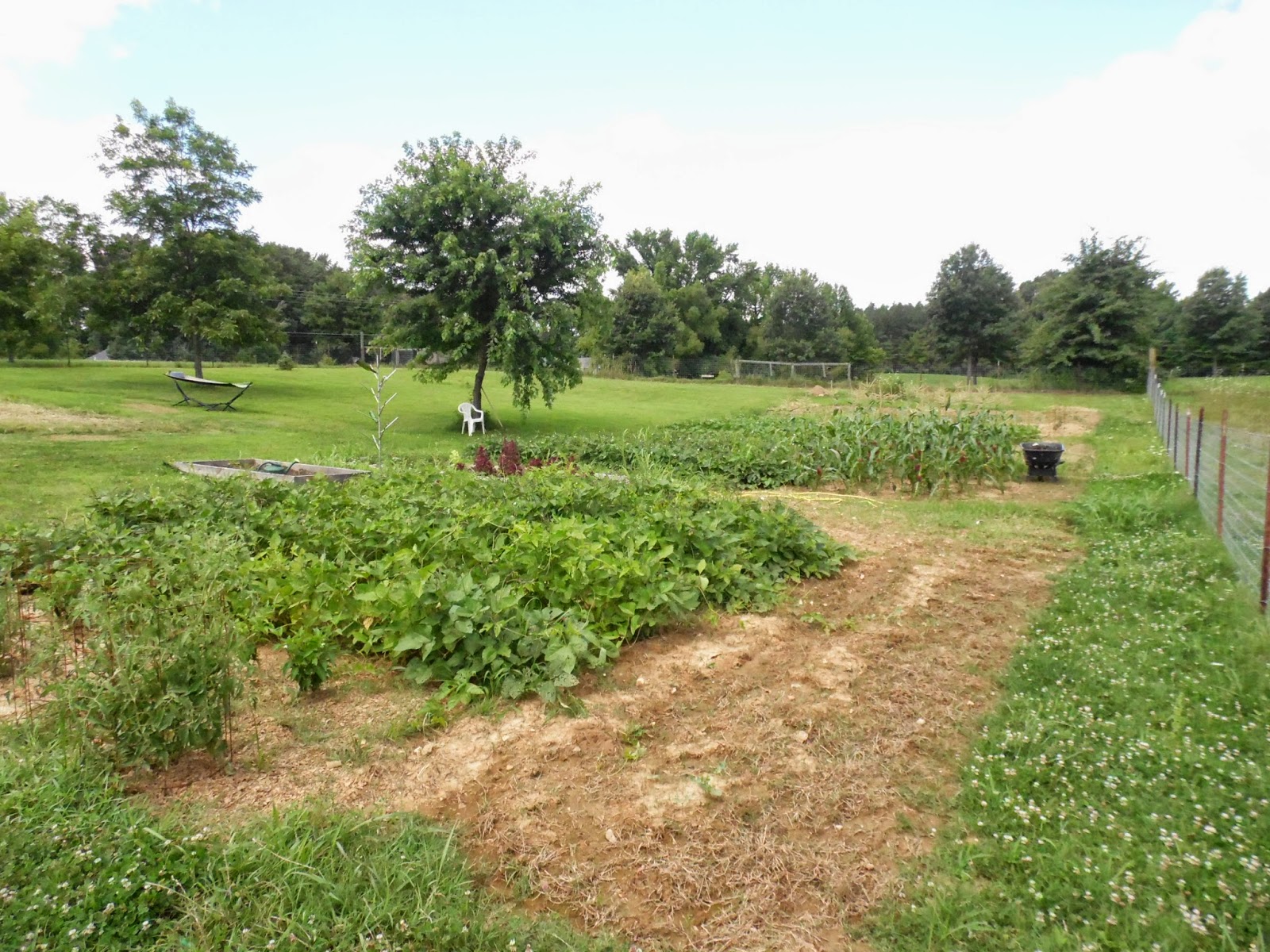
Anyway, we've reached the middle of the season. The garden has slowed down now that everything is planted. There's quite a bit of weeding to do if it will stay dry long enough, which you shall see in the images, but the rush to get things in the ground is over. This spring's kids are almost old enough to go their new homes, and the fall birthing season is still a couple of months away. The garden isn't ready for harvest just yet. All in all, things have hit their stride and will be much lower maintenance for a few weeks...at least in theory. :)

Our poor little bottle tree is sparse looking! We'll have it fleshed out soon, though.
We've had some trouble with our tomatoes. We lost a few plants to Southern Blight/white mold, and have been picking leaves off of others as they get affected with blight. The warm wet weather we've had is what fuels fungus such as blight. Milk washes, baking soda drenches, and apple cider vinegar water have helped some but it's an ongoing battle. We also lost our first, biggest tomato to a renegade hen who jumped the fence. They're making again, though, so I'm hopeful we'll at least end up with enough for one batch of salsa!

He was going to be a pretty one, but alas. The chicken beat us to it.

Can you believe this puny plant, which has really struggled with blight, has a tomato?
The lettuce has bolted, so its season is over until the fall. So pretty, though, isn't it? It could practically be an ornamental.


The bush peas are doing the best, as always. Peas are pretty fool-proof. We've never had a failed crop with them. They're blooming and vining and making tiny pea pods. We'll be having fresh peas for supper in no time!


Our bush lima beans are doing well, too. Lima beans are my favorite legume.


We planted a later crop of pole beans and peas, and they are coming up well...but so are the weeds!

Our cantaloupe is blooming. The first blossoms won't make fruit, but it's a sign that my favorite melons are on the way!


I planted a few sweet potato plants, which is a first for us. They haven't bloomed yet but are doing well, aside from the weeds that are over taking them! Yikes!


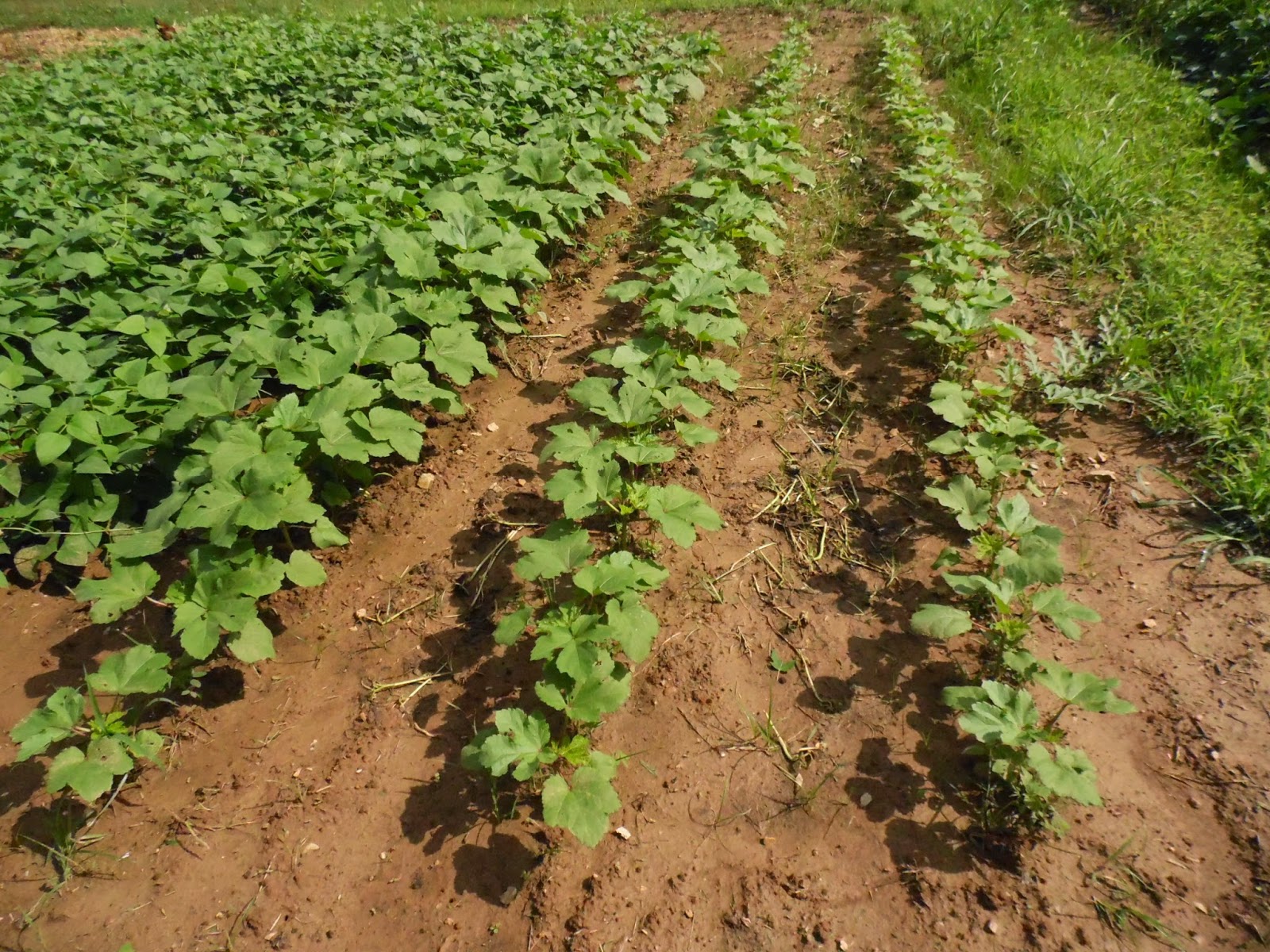
Okra is growing like a weed, too...but it also needs to be weeded, as you can see.

Can you spy the volunteer watermelon?
Our watermelon got planted late, but it's coming on. Our garden retains moisture well, but sometimes in a rainy season that means complications in planting and weeding!


We also planted an Arkansas Black Apple tree this year. It won't produce for a few years. We may not even be living on this land by the time it's in full swing, but it's never a bad investment to plant a tree.


Our pumpkin patch, which I don't have pictures of, is doing really well. However, it is the worst for the weeds. Right after we planted the rains came and didn't let up for a while, and the weeds just took off. We'll be tackling it this weekend, and working on weeding and mulching the rest throughout the weed.

We also have some new life here at Tiramar. Our broody hen just hatched several (I just realized I haven't even counted them! Whoops!) pheasant eggs and one chicken egg. (I put a chicken egg under her with the pheasant eggs just in case, so that she wouldn't reject the smaller eggs.) One hatched out weak and has had to spend a lot of time indoors. I'm not sure he will make it. I tried returning him to mama, but he just wasn't strong enough yet and I had to remove him again. A second chick had a really rough hatch and spent the first 24 hours indoors, but I have since returned him. He is doing so well that I can't even tell which one he is at this point. These guys will stay with our hen in the off-ground brooder for a while and then be transferred to a tractor, where they will finish growing out. I'm hoping a couple might be butchering age in time for Christmas dinner. Hopefully the chicken chick, which came from our RIR rooster and a Black Copper Maran egg, will be a hen!

Yes, they are in a modified laundry basket. Their wooden nest box ended
up not being big enough, so we had to improvise!
You can somewhat tell in this image how much bigger the chicken chick is.
Is this one giving me the stink eye?
Clever camouflage, but I can still see you.
Now we weed, and then we wait for the harvest and for the time to start planting our fall crops. Fall goat kids should be on the way, too. We won't be in a lull for long!

Cheers!

Tuesday, July 1, 2014

Lessons from Nancy

Believe it or not, I actually get a chance to read fiction novels from time to time. Sure, summer is arguably the busiest season for a homestead, but sometimes I just can't help but pick up a book that isn't going to teach me something...at least not in the same way as nonfiction books.

As you may have guessed by my title, my recent books of choice have been the Nancy Drew series. I read this series first as a child, and I decided it was time to revisit the stories I loved back then. Books tend to reveal more when they are read more than once, and Nancy Drew is no exception. I think there are a lot of life lessons we can learn from Nancy, and I decided to share a few of them here, including a few that I feel correspond directly to homesteading.


  1. Nancy is always kind. Even to complete strangers she meets along the way, she stops to lend a helping hand.  If someone asks her for help, even if it might put her in danger or inconvenience her, she is there to do what she can. Nancy does for the least of these, and never asks for anything but friendship in return.
  2. She avoids gossiping, but knows when to listen to it. There's a fine line between engaging in the spreading of rumors and simply engaging in conversation -- a line all of us have crossed, if we're honest -- but Nancy always stays on the right side. However, she doesn't simply avoid it and walk away. Nancy knows how to listen, and not just to lend a sympathetic ear. She picks up on important details that can help her down the road. Oftentimes we can benefit by simply listening to what others say and keeping our own mouths shut.
  3. She is honest. Nancy does not lie or hide the truth, and this makes her a trustworthy person in whom people feel comfortable confiding. People know that Nancy will not deceive them or take advantage of them. When they come to her with a problem, she will truly try to solve it, not benefit from it in some way, and she will give her honest opinion and advice. Honesty is the best policy.
  4. She has a wide variety of useful skills. Nancy knows how to do just about anything. She is a quick thinker, she is skilled, she can do most things for herself, and she is excellent at troubleshooting when the first trial fails. Nancy is not the type to have others do everything for her. Having a wide skill set and the ability to troubleshoot is absolutely necessary to homesteading, and one of the essences of homesteading is doing things for oneself. To homestead is to develop a variety of useful skills.
  5. Nancy knows when to seek counsel. Nancy is a smart girl. As the point above notes, she has no trouble figuring things out on her own or getting stuff done. Yet this does not stop her from seeking out advice when she needs it, whether it be from her father, Hannah Gruen, an authority, or a trusted friend. She is wise enough to recognize that multiple people coming together can solve a problem much faster, and that even the smartest and most self-sufficient folk need some advice now and again. Homesteaders sometimes get caught up in the "I need to do this myself" attitude, but there are times when we do need help. And that is okay.
  6. She doesn't let her age or inexperience interfere. Nancy would never be the type of person to make an excuse for anything. Thoughts such as "I'm too young" or "I've never done this before, so I can't do it now" never enter her mind. Instead she faces trouble head on with the certainty that one way or another, alone or with friends, she can accomplish her goals. No excuses. So what if you've never raised chickens before? You can do this.
  7. She is brave. I will be the first to admit that I am not going to follow strangers down deserted roads or climb through dark, hidden passageways like Nancy does. Truth be told, some risks really shouldn't be taken, especially alone. There's still a lesson here, though, and it applies amply to homesteading. Homesteading involves risks. "What if I don't get a return on this investment? What if something happens to my livestock? What if my crops fail? What if that [insert large animal here] tramples me?" There are a lot of "what if's," but the one sure thing is that homesteading requires a good helping of hope, faith, and even bravery. Sometimes you just have to dive in and pray it works out.
  8. She develops strong, positive relationships. Nancy has a wide network of friends and relatives with whom she has good relationships. She doesn't let being busy keep her from socializing. In fact, she incorporates her work with the development of her relationships in many ways. Homesteading is an isolating lifestyle. (And trust me, I am the worst about being a hermit homesteader.) The work, though usually enjoyable, is time consuming and tiring at times. It's hard to go out for a night on the town with friends when you have to wake up the next morning to milk your goats. And sometimes it's hard to connect with people who don't share your lifestyle. Not everyone understands the desire to homestead or cares to hear homestead-related anecdotes. But connecting with other humans is important not only for our emotional well being, but also to build a network of people to whom we can turn in times of need or share with in times of bounty. We get by with a little help from our friends (and family).
  9. Nancy appreciates the great outdoors. She enjoys being active outside, taking hikes, spending time on the lake, or just enjoying nature. In book 2, The Hidden Staircase, Nancy mentions that her father taught her that nature is a great way to clear one's mind. It is such a valuable thing to appreciate nature and enjoy time spent in the outdoors...especially if you homestead. All that garden and livestock time will be spent outdoors, of course, and you will likely find that you enjoy that much more than indoor chores.
  10. She never gives up. Nancy embodies tenacity. Even when she's down to nothing, at her wits end, locked in a closet by burglars, or generally in a situation that seems hopeless...she just keeps trying. Those of us who homestead know that some days, months, and even years on a homestead are hard. Sometimes it seems like everything we plant dies, the weeds are overtaking our entire lives, the weather is against us, and/or our livestock just keep having problems, illnesses, injuries, or even deaths. Homesteaders must be tenacious if we are to keep homesteading. Sometimes the going gets tough, but the tough keep going!

Sunday, June 22, 2014

5 Tips on How to Raise Grass-Based Dairy Goats


If you clicked on this, you are probably already familiar with the amazing health benefits of grass-fed dairy and meats.  If you're not, click each of those links to learn just a little bit about why pastured animal products are so much better than the typical grain fed foods you find on most grocery shelves. Once you've got that out of the way, you can come back here and learn how to implement a pasture-based system for your own dairy goats! These tips can be applied to other animals, too.

First of all, while most sources will say that 100% grass fed is the way to go, it's really not a feasible system for most small livestock growers. My own animals are not 100% grass fed. However, it is extremely possible to have grass be the basis of your dairy goat's diet while allowing good quality grain -- preferably without soy -- to take up only a very small percentage.

So, without further ado, here are my tips for transitioning your goats to a pasture based system:


1. Find good quality hay. Outside of the growing season, hay will be the main ingredient of your goats' diets. Your hay will essentially be the pasture for your goats, so it is important to find a good source of hay. Your producer should be able to consistently provide you with hay that is not overly dry (and therefore nutritionally dead) or too wet (wet hay will mold or even catch fire). It should also not contain too many unpalatable, stalky pieces or undesirable weeds and should be free from toxic plants or leaves. Your best bet is to build a rapport with a reputable hay provider and purchase from the same person year after year. Many of the best producers, particularly during dry years, will have a waiting list or sell out quickly, so stay on top of this and reserve your hay early in the season.

2. Rotate your pastures. A rotational grazing system is the best way to make optimal use of your land and to keep your goats healthy. The ideal system will actually employ two unrelated livestock species, one of which will graze after the other. For example, you may run horses or pigs on pasture after goats (more on that in the next paragraph). Regardless of whether your system is multi-species, you will need enough pasture areas to allow the land to lay empty between uses. Allowing the land to rest in between periods of grazing allows the grass to grow back to its ideal height -- above 4" -- before its next use. This also prevents your land from becoming bare and washing away into gullies, and it helps prevent your livestock from becoming reinfected with internal parasites.

As your goats browse, they shed parasite eggs and larvae onto the ground. The majority of these little nasties stay below 4" (which is as high as the barber pole worm larvae -- the most common internal parasite in adult goats -- can climb). By rotating your goats off of pasture that has been mostly consumed to or below 4", you prevent them from picking up more parasites. It also helps to graze a different family of livestock species behind your goats, such as pigs or horses. These species do not share many parasites with goats and will be able to "clean" the field. They will also eat down the grass that your goats likely ignored in favor of juicy weeds.

How long you are able to graze your goats in each field and let your other field(s) rest depends on the number of goats you are grazing. A low stocking number will be able to stay on one field longer, while a higher stocking rate will mean rotating them through faster (and may also require more fields through which to rotate them). A good beginning rule of thumb is to allow at least a month for fields to rest in between use. This book by Carol Ekarius is an excellent resource for learning more about rotational grazing practices:


3. Give your goats proper mineral supplementation. Mineral deficiencies can cause all sorts of problems for goats. Goats should always have free choice access to a high quality loose mineral formulated specifically for goats. Do not buy sheep/goat mineral, as sheep cannot have additional copper without suffering from toxicity, while goats absolutely need copper to have a healthy reproductive system, parasite resistance, healthy hair coat, and overall good health and immunity. I prefer to use Sweetlix Meat Maker (non-medicated, and yes, it works just fine for milking animals, too!). Goats have soft tongues and no upper teeth, so a loose mineral is necessary for them to consume enough, and the mineral should be the only source of salt or minerals available. 

Many areas of the country are also either low in copper or high in another element that binds with copper and prevents its appropriate absorption. For this reason, many goat breeders must supplement copper specifically, typically by administering a copper bolus every 4-6 months. It is also a common practice to supplement selenium through selenium/vit e gel. In my own herd, I administer copper boli every four months and selenium/vit e gel to prior to breeding and one month before kidding in pregnant does. This system works very well for me, and the results from the copper supplementation are incredible. Signs of copper deficiency include "fish tail" (balding of the tip of the tail); dull, faded, or rough coats; failure to shed the winter coat; failure to conceive or carry pregnancy to term; low birth rates; difficulty resisting parasite infestation; and, in severe cases, continual decline resulting in death. Selenium deficiency causes white muscle disease, failure to conceive, low birth rates, impaired vision, weight loss, and kids born with weak legs that may fold under at the pasterns and/or an inability to stand. 

To learn if your area is deficient in copper or selenium, check out these mineral maps, ask reputable breeders or livestock veterinarians in your area, and watch for the signs of deficiency. You can also have your forage and water checked for mineral levels (check for both the minerals you need and the minerals that will bind with them and prevent absorption, such as sulfur) and, in a worst case scenario, have your deceased goat's liver biopsied for mineral levels.
This is a map of copper levels in the US. Remember that other minerals also bind with copper to prevent absorption. Where your hay or pellets come from matters as well. My location is in the blue, but I still have to supplement copper regularly.
4. Choose your feed wisely. Lactating does and does in late pregnancy have higher nutritional needs that dry does, wethers, or bucks. They will need supplemental feed beyond grass hay and browse in order to maintain their body condition and produce milk. Alfalfa, which is technically a legume and not a grass, is needed for them to meet their bodies' high demand for calcium. Some areas of the country can find alfalfa hay, but it can be difficult to find in some locations. In my location, the best source for alfalfa is in pellet form, and this is what I feed my girls when they are producing. Choose a brand with pellets that have a low dust amount and a good green color (not a dull brownish shade). 

In most cases, producing does also need some amount of grain. Grain will be a small portion of the diet, because while the does will only receive grain once or twice a day on the milk stand, they will be eating browse or grass hay all day long. Appropriate amounts of grain are not evil! Supplementing an animal with grain when it makes sense and is necessary is not going to be detrimental to the animal or to you; in fact, it will be beneficial because it will keep the animal in good condition and support a higher level of production. This is not the same as sticking your goats on dry lot and feeding them nothing but grain, which will definitely impact the health of the animal and the quality of the milk.

You should still choose good sources of grain. I prefer to stay away from soy, and so I have transitioned my girls from a premade goat pellet to a hand made mix. I am following the recipe #3 on the Land of Havilah website. I recommend staying away from soy for a number of reasons, but if mixing your own is out of the question for you, you can look for organic livestock feeds or soy-free brands. If this is also impossible for you, avoid sweet feeds with high molasses contents and provide a pellet formulated for goats. Grain of any kind in too high of quantities is bad for the rumen and can cause excess weight gain and acidosis. Grain should also not be fed to bucks or wethers in order to prevent urinary calculi. The generally recommended ratio of alfalfa to grain is 3:1. A good rule of thumb for feeding grain is to feed 1lb for every 3lbs of milk your doe is producing. This should be adjusted to how well your doe is maintaining her body condition. If she is dropping weight (and is not suffering from a parasite overload or illness), she needs more; if she is getting fat, she needs less. Be very careful not to start giving grain too early or too much in pregnancy as this can lead to over-sized kids and ketosis and/or hypocalcemia. 

I personally start giving very small amounts of grain in the last week or two of pregnancy and then gradually increase after the doe gives birth. While milking, I allow my does to eat as much alfalfa pellets as they want on the stand (unless they're really going overboard or gaining too much weight) alongside the appropriate amount of grain. 

Browsing is fun for all ages! 
5. Make changes slowly. All dietary changes for goats (or any animal) should be made slowly. Goats have a delicate digestive system and can suffer from dangerous and potentially deadly bloat is they are transitioned from one diet to another too quickly. If your goats have not previously been on pasture, introduce them gradually by allowing them to be out for 30 minutes to an hour the first day and increasing that time by 30 minutes to an hour each day until they are spending the entire day on pasture. At that point you can continue to lock them in the barn at night for increased safety or you can allow them to remain out 24/7 as long as they have appropriate shelter available. Always provide your goats with free choice baking soda to settle their rumen if it becomes upset. They will eat baking soda instinctively if they need to alter their rumen ph. Also know the signs of bloat and be prepared to treat it. If your goats seem a little off after a change in feed but aren't showing signs of bloat yet, massage their left side (the location of the rumen) until they begin to burp and pass gas. Some loose stool after the introduction to new, rich forage is not something to be concerned about unless it is excessive or does not go away. Just limit their time out a little and increase it more slowly and their stool should return to normal within a day.

Goats will eat many weeds that other species, like horses, typically will not. 
Bonus! 

6. Check your pastures for toxic plants. The toxicity of many plants for goats is debated. Many, including myself, believe that the level of exposure greatly impacts whether or not some types of plants thought to be toxic will harm your goats. However, you should be aware of toxic plants in your area and know that some -- like Yew or the leaves of stone fruit trees (cherry, peach, plum) -- are deadly even in small amounts. Watch out for these plants and do not graze goats in areas that contain them. Also beware of leaving your goats on pasture too long, because the plants they might have avoided eating at first -- which may or may not be toxic to them -- will become more appetizing as the other options diminish. Fiasco Farms website has a good article on toxic plants. You can check with your extension office or do a search to find what toxic plants are native to your particular area. Do not allow people to feed your goats clippings (and avoid doing so yourself) unless you are absolutely sure that the plant is safe.


Having pasture-based goats is very simple once you are set up for it. It's truly a natural lifestyle for the goats, and they will be very content when eating browse. Even though you should provide grass hay during the summer for them to munch during barn rest or rain (goats need to eat frequently to keep their rumen going), they will eat very little when they have ample browse. You may even be surprised to find that your milking does voluntarily eat less grain when they are on pasture! :)

Sunday, June 15, 2014

A Surprise Addition

We had a week of stormy weather here in the beginning of June. Thankfully it wasn't severe, but of course animals who are afraid of storms do not know that. It was during one of these storms that my mom found a little brindle and white dog running the roads, terrified, and brought her home.


We posted about finding her in various places, looked for "lost dog" signs, called the vet and the shelter, checked her for a microchip, and asked at houses near where she was running, but nothing ever came of it. Because of her extremely fearful attitude and the fact that she got readily into Mom's car when she stopped but was afraid to get in it to go the vet, we believe that she may have been dumped.

Eventually we came to the decision that we might as well keep her. What's one more, right? She has also gotten slowly more used to us, and it would be a huge upset for her to be moved into another home and out of ours. When our Collie mix Sophie met her, it was obvious that she wanted to play, but the little girl didn't seem so enthused. I made a joke referencing that old Loony Toon's episode (which was referencing Of Mice and Men): "I will name him George, and hug him, and pet him, and squeeze him..." And thus the little dog became "Georgie."


Georgie is still very fearful, but is not aggressive or a fear biter. She is also a little thin, but she is eating well and should gain some weight soon. She still spends most of her time hiding, but she gets along with our other critters and is sweet when she interacts with us. She is, however, more afraid of Dad than of Mom and I. We have to wonder if perhaps she was abused by a man at some point based on her attitude. Lavender aromatherapy does seem to help her, as does giving her treats (of course!). The vet has cleared her health and believes that she is between two and four years old, but closer to two. We hope that she will continue to improve and meld into our family with time.


Update: Unfortunately, we need to find a new home for Georgie. See this post.